
Glendale Parking Lot Striping lays ADA parking striping to California requirements across Glendale, CA and surrounding cities including Burbank, Culver City, South Gate, Montebello and Arcadia. This is the highest-exposure square footage on any commercial lot, and it is the area where meeting the federal standard alone still leaves a property non-compliant.
The distinction that governs everything on this page is simple. The number of accessible stalls a lot owes is a federal question, and the California table matches the federal one exactly. Where California departs is in how each of those stalls must be sized, marked and signed, and it departs substantially. A lot built to the federal standard can have precisely the right number of stalls and fail on every one of them.
There is also a correction window worth knowing about before anything else. California treats faded, chipped or deteriorated paint in parking spaces and access aisles as a presumed-harmless technical violation when it is corrected within fifteen days of notice. That single provision is why a striping contractor is often the right first call rather than the last one, and why we prioritize scheduling for owners who are working against that clock.
Where California Exceeds the Federal Standard
Stall Dimensions
California requires a wider car stall than the federal standard, and specifies a minimum stall length where the federal standard specifies none at all. Van spaces are wider again. These are not rounding differences; they are the difference between a compliant layout and a finding, and they are the single most common reason an otherwise well-built lot fails an assessment.
Retrofitting width into a finished lot almost always costs stalls elsewhere, which is why we work to the California dimensions from the drawing stage rather than discovering the problem after paint is down. On a tight site that trade-off is worth modeling before anything is committed, because the answer sometimes changes where the accessible stalls should sit.
The Access Aisle and Its Markings
Every accessible stall needs an adjacent access aisle, and California requires that aisle to be bordered in blue with hatched lines inside it and the words NO PARKING in white letters at a specified minimum height. The federal standard says only that the aisle be marked so as to discourage parking, and explicitly leaves the method to state law, which is precisely the gap California fills with a far more prescriptive rule.
California also requires the van access aisle on the passenger side for every van space rather than only for angled ones, which is a detail that catches out layouts copied from out-of-state drawings. It is a small change on paper and a significant one on a lot where the aisle was already placed on the wrong side.
The Symbol on the Pavement
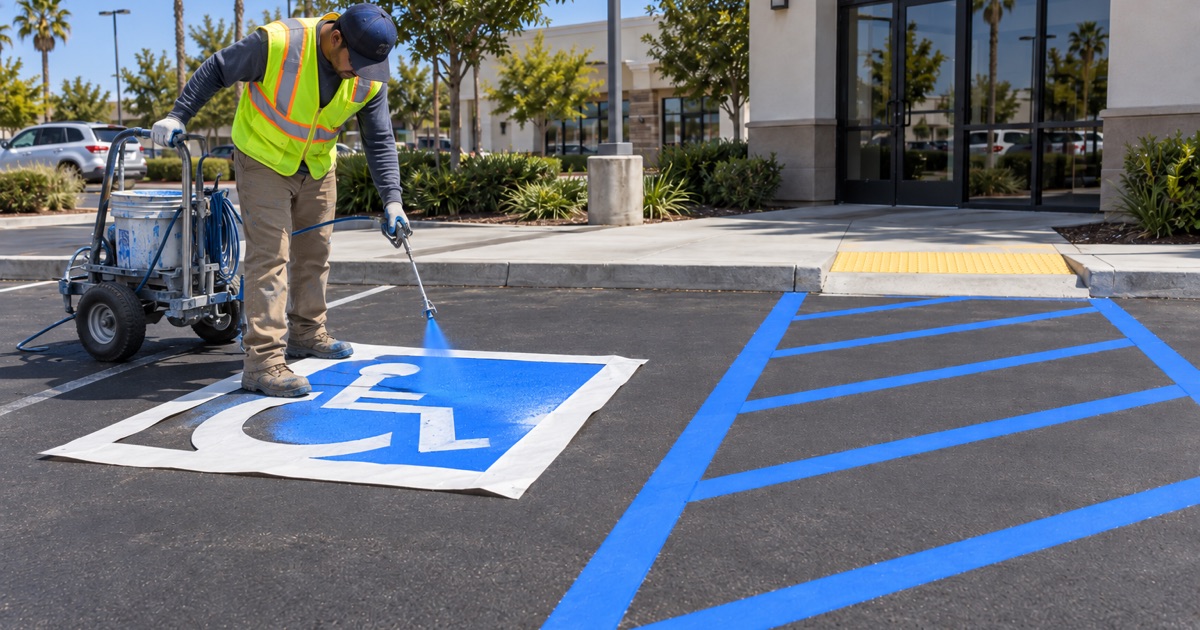
California requires the International Symbol of Accessibility painted on the surface of each accessible stall at a specified size, which the federal standard does not require at all. It is laid to the state standard plan detail rather than freehand.
A symbol drawn at the wrong proportion is worse than a missing one in practice, because it demonstrates that someone attempted the requirement and did not meet it, and it is trivially photographed by anyone building a complaint. We use correctly sized stencils and set them square to the stall. Laying it to the state standard plan detail also means the symbol matches what an inspector is holding when they check it.
Signage, Enforcement and the Route
The Stall Sign
Each accessible stall carries a sign showing the accessibility symbol in white on blue, reflectorized, at a minimum area, and California requires specific minimum fine wording on it. A correctly striped stall with a missing, faded or non-compliant sign is still a finding.
Properties also require tow-away signage at entrances, at its own specified size and lettering. We supply and install signage as part of the striping visit rather than leaving it to the client to source separately. Sourcing signs independently is where properties most often end up with a sign that looks right and does not meet the specification.
Enforceability Depends on the Marking
California vehicle law is what makes disabled parking markings enforceable against a vehicle, which means an unmarked or badly marked stall is not merely a compliance problem but an unenforceable one. A property manager who cannot have a vehicle removed from an accessible stall has lost the practical use of it.
The same logic applies to fire lanes and to red curbs, which is why we treat marking and enforceability as one question rather than two. A restriction nobody can act on is a sign, not a control.
The Accessible Route
An accessible stall is only useful if the route from it to the building entrance is itself accessible, which brings in cross slopes, curb ramps, detectable warnings and the absence of obstructions such as badly placed wheel stops. Striping alone does not fix a route problem, and treating it as though it does is how a property ends up with an immaculate stall that still cannot be reached by the person it was painted for.
We are straightforward about the boundary here. Where a route needs civil work, we will say so rather than painting a compliant-looking stall at the end of a non-compliant path. Obstructions are the exception we can usually solve on the spot, because a badly placed wheel stop or sign post is our work to move.
Maintenance, Inspection and Exposure
Maintenance Is a Code Obligation
The California Building Code requires accessible features to be maintained, which means a weathered symbol or a faded aisle border is a live code issue and not only a litigation risk. This is the clause that moves striping from a cosmetic budget line to a compliance one.
We check accessible stalls, aisles and signage on every visit to a property as a matter of course, whether or not that was the work we were called for, and we report the condition in writing. Catching a weathered symbol during a sealcoat visit costs almost nothing; discovering it through a complaint costs a great deal more.
What a CASp Inspection Does
A Certified Access Specialist inspection is carried out by a state-certified inspector, not by us, and it produces a report carrying specific procedural protections if a construction-related accessibility claim is later filed. We work from a CASp report where a client has one, and we tell owners plainly when obtaining one is worth the cost.
Any contractor who offers to perform a CASp inspection alongside the striping is describing something other than what that term means. We would rather lose the add-on than blur it, because the protections attach to the inspection being genuinely independent.
Why This Area Draws Claims
The state commission that collects data on accessibility complaints publishes what is actually alleged, and parking sits at the top of that list by a wide margin, with several of the most common categories describing the parking area alone. California maintains its own procedural machinery around these claims, including reporting duties on attorneys sending demand letters and a statutory definition of a high-frequency litigant.
Set against that, bringing a non-compliant stall into specification is a small and bounded cost. The arithmetic is rarely close, and there are even local programs funded by an accessibility fee that some small businesses can draw on.
- 20+ Years Striping Commercial Lots
- ADA Layouts Checked to Chapter 11B
- Night & Weekend Scheduling