
Glendale Parking Lot Striping handles parking lot striping in Alhambra, CA for the multi-tenant retail plazas that make up most of the city’s commercial parking. A plaza is not one lot with one owner’s priorities. It is a single field of pavement serving a dozen businesses whose customers arrive and leave on completely different rhythms, and marking it well means treating that mix as the design problem rather than an inconvenience.
The defining characteristic here is turnover. Plaza parking cycles through far more vehicles per stall per day than an office or industrial site ever does, and every one of those cycles puts tires across the same lines. The practical consequence is that a plaza’s markings reach the end of their service life on a shorter clock than identical paint would on a lot full of long-stay parkers.
That is a budgeting fact before it is a technical one. A property manager who puts a plaza on the same maintenance cycle as a business park will be fielding faded-line complaints well before the schedule says the lot is due. We quote and inspect against the cycle the traffic actually justifies, because the alternative is discovering the gap one tenant email at a time.
Multi-Tenant Plaza Parking
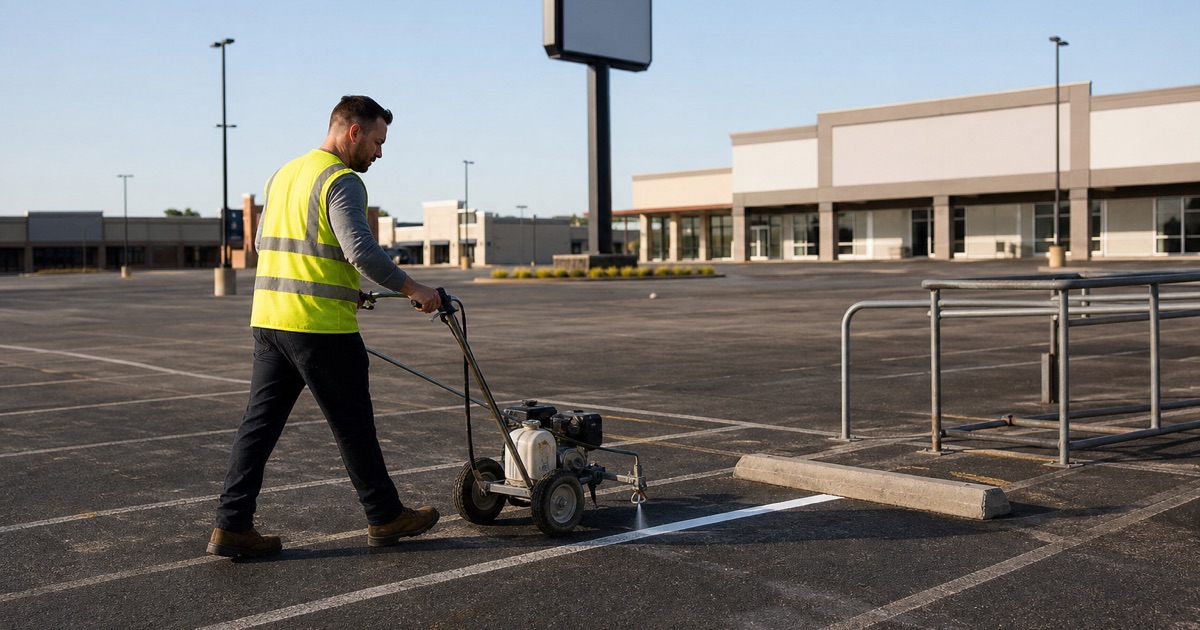
A Layout Drawn Before Any Paint Is Mixed
On a plaza the stall count is contested territory, because every tenant believes the parking in front of their door belongs to their customers. We draw the layout and get it approved before any paint reaches the asphalt, which turns that argument into a conversation about a drawing. Settling it on paper costs an afternoon, and settling it after the lines are down costs a removal job.
The drawing also makes the trade-offs visible. Widening the stalls nearest a busy frontage takes spaces from somewhere else on the field, and a plan on paper shows exactly where they came from. A manager who can see that choice tends to make a better one than a manager reading a finished lot and working out afterward what happened.
Stall Count Is a Leasing Question
Parking counts appear in leases, so a re-mark that changes one is a document problem as well as a pavement problem. We ask what the leases assume before proposing anything that moves a total, because a layout that gains spaces is not automatically an improvement to the person who signed for a specific number. A landlord who learns about it afterward is entitled to be annoyed.
Where a count genuinely can improve, it is usually through geometry rather than compression. Changing the parking angle, straightening a wandering aisle or reclaiming a dead corner recovers spaces without narrowing anything a customer will notice. Those are the gains worth chasing, because they survive a tenant walking the lot with a tape measure.
Circulation Between Frontages
Plaza customers do not park once and stay. They move between frontages, sometimes on foot and sometimes by driving to the other end of the field, and the circulation has to make both of those legible. Most plazas we survey mark their drive aisles competently and their walking routes barely at all.
That gap is where the complaints come from. Somebody carrying bags across an unmarked aisle behind a row of parked cars is a hazard the layout created rather than one the driver invented. Marking a continuous path across the field costs very little against the exposure it removes, and it is visible to every tenant on the property.
Looking for parking lot striping closer to West Hollywood? See West Hollywood Parking Lot Striping.
Turnover and the Rate Markings Wear
Where the Wear Actually Concentrates
Wear on a plaza is never even. The entry throat, the aisle serving the busiest frontage and the stalls in the first rows absorb a disproportionate share of the traffic, and they fade while the far corner still looks nearly new. Reading a lot by its worst area rather than its average is what produces an honest interval.
We photograph the survey by area for exactly that reason, rather than taking one shot of the best-looking row. A record organized that way lets a manager schedule a partial re-mark on the rows that need it and leave the rest alone. It also makes the next inspection a comparison against something rather than a fresh opinion.
Choosing Paint for the Traffic It Will Take
A cheap re-mark and a durable one look identical on the day they are finished, which is why our quotes name the paint and the application rather than only the price. On a high-turnover field that distinction is most of the value of the job. The wrong specification does not fail immediately, it fails partway through the interval somebody has already budgeted for.
Alhambra sits in the western San Gabriel Valley, and like every lot in the basin its coatings fall under South Coast Air Quality Management District Rule 1113. Traffic coatings are limited there to 100 g/L of volatile organic compounds. That constrains what a bid can honestly propose, and it is worth asking a low number whether it respects the limit.
A Written Interval Instead of a Complaint
Every faded-line inspection we carry out comes back with a written re-mark interval rather than a verdict on the current condition. A property manager can put an interval in a budget, whereas a photograph of a worn stall only confirms that they are already late. On a plaza that interval runs genuinely shorter than the general rule of thumb, and saying so is more useful than being agreeable.
There is a compliance edge to this as well. California Civil Code Section 55.56(e)(1)(F) allows a property owner a 15-day window to correct faded parking and access aisle markings once they have been put on notice. Knowing the lot’s condition ahead of that letter is worth considerably more than knowing it afterward, and a dated set of photographs is what makes the difference.
One Field, Several Leaseholds
Who Owns the Line Between Two Tenants
Multi-tenant property creates boundaries that exist on a lease plan and nowhere on the pavement. Two tenants share an aisle, one of them repaints their own frontage, and the field ends up with two different stall widths meeting in the middle of a row. We would rather mark the whole field once than inherit that seam and try to disguise it.
Where a single re-mark is not possible, the fix is to agree the specification first and let the areas be done separately against it. That keeps the plaza legible even when the work is funded by different parties on different dates. A shared field only reads as one lot if somebody has written down what one lot means here.
Sequencing Around Different Trading Hours
A plaza rarely closes, because the tenant that shuts in the early evening sits alongside one that trades late and another that opens before the commuters do. There is no single window when the whole field is free, so we section the work and keep part of the lot open throughout rather than closing the property. Night and weekend scheduling is the default here rather than an upgrade.
Getting the sequence right is mostly a matter of knowing which areas each tenant actually needs and when. A restaurant needs its frontage back before the evening trade and a service business genuinely does not care, so the two can be done on opposite nights. We agree that order before the crew arrives rather than negotiating it on the pavement at midnight.
Removing the Previous Plan
Plazas accumulate layouts. A tenant change moves a loading zone, a reserved bay is added and then abandoned, and within a few cycles the pavement carries several plans at once with no way to tell which one is current. We remove old markings rather than paint over them, because a covered line reappears as the new coat wears.
That matters more on a high-turnover field than anywhere else, since the new paint is worn back faster and the ghost lines surface sooner. Grinding an obsolete layout off costs more on the day and less across the interval. It is also the only approach that leaves a driver reading the current plan instead of an average of every plan the lot has ever carried.
Access, Signage and Devices Across a Plaza
Accessible Stalls in a Shared Field
Accessible parking on a plaza has to serve several entrances rather than one, which is a harder problem than the count alone suggests. Stalls concentrated near the anchor tenant leave the far frontages with a long route, and the route is as much a part of the job as the stall is. We check stalls, aisles and signage against current code on every visit rather than only when a client raises it.
Under the federal 2010 ADA Standards the number of accessible spaces owed is a function of how many the lot provides altogether, and on a plaza that figure is often larger than anyone remembers. A field that grew by absorbing an adjacent parcel is the usual reason a count that was once correct is short now. We recount rather than assume.
Signage That Accumulated Over Leases
Signage on multi-tenant property gets installed by whoever needed it, whenever they needed it, which is how a plaza ends up carrying reserved-bay signs for businesses that left years ago. Auditing what is standing is usually worth more than adding to it. A sign that contradicts another one further along the row is worse than no sign at all, because it hands anyone disputing an enforcement action a ready answer.
Signage is supplied and set by the same crew on the same trip as the marking, which keeps a stall and the sign governing it on one specification instead of two. On a plaza that also means one party is accountable when a sign is faded, obsolete or pointing at a bay that no longer exists. Splitting the work between trades is how the contradictions started.
Wheel Stops, Bollards and What Sits Under the Paint
Wheel stops and bollards fail quietly on a busy field. A stop cracks under repeated contact, a bollard at a storefront is struck and never replaced, and neither gets logged because neither is any single tenant’s responsibility. We replace damaged units during visits already scheduled for marking, which costs a fraction of a separate mobilization.
Placement matters as much as condition on a plaza, because a stop protecting a storefront under a previous layout ends up stranded in the middle of the new one. We set them against the drawing rather than against the marks left in the old paint. The surface underneath gets recorded on the same visit, since fresh lines over failing asphalt disappear along with the asphalt beneath them.
- 20+ Years Striping Commercial Lots
- ADA Layouts Checked to Chapter 11B
- Night & Weekend Scheduling











