
Glendale Parking Lot Striping provides parking lot striping in Arcadia, CA for some of the largest single parking fields anywhere in our service area. Event parking and regional retail here operate at a scale where the ordinary assumptions about a marking job stop applying, starting with the idea that a property can be re-marked in a night.
Scale changes the arithmetic of everything. A field that holds thousands of vehicles has more marked pavement on it than a dozen retail lots put together, its work spans many sessions rather than one, and a decision taken at the drawing stage gets repeated across an enormous area before anyone sees the result. Errors here are expensive because they are multiplied rather than isolated, and they are discovered at the point where correcting them means going back over everything.
The second condition is that demand on these fields is not steady. Event parking is close to empty for long stretches and completely full for a handful of days, and regional retail runs a pronounced seasonal peak. Both are judged on the days they are full, which are exactly the days no work can happen. Everything we do on these properties is therefore scheduled against a calendar somebody else owns and will not move.
Event-Scale Parking Fields
Filling and Emptying Are Two Different Problems
An event field takes on most of its vehicles inside an hour and releases them inside about the same, and those two movements need almost opposite things from a layout. Arrival wants direction and distribution across the field, while departure wants merge points that do not compete with each other. Designing for one and inheriting the other is the normal outcome, and it is visible on every event day.
Most sites we survey have marked the arrival case and left the departure to work itself out, which is why the memory people leave with is the queue. We mark the exit routes and their merge points explicitly, because a driver who knows where they are going merges and a driver who is guessing stops. One stopped car at a merge point is a field-wide problem.
Marshalling Ground That Is Not a Parking Lot
Large-event property nearly always includes ground used for marshalling rather than for stalls: holding areas, staging for buses and coaches, and areas where staff direct traffic into a pattern that exists mainly in their heads. Those areas do more work on a peak day than half the marked stalls, and they are almost never part of what a striping contractor is asked to quote for.
Marking the marshalling pattern makes it a property asset rather than institutional memory in a small number of people. It survives a change of staff, it lets somebody unfamiliar run a gate, and it settles what happens to accessible parking and emergency access when the field is at capacity, which is precisely when an informal arrangement gives them up.
Marking Something You Intend to Remove
A share of the marking on event property is genuinely temporary: an arrangement for one season, a layout for a particular kind of event, a division of the field that will not apply next year. Marking those conventionally leaves the property carrying instructions that stopped being true months ago.
Where a requirement is short-lived we say so at the quote stage and specify accordingly, then take it off properly rather than letting it fade into ambiguity. Removing it is part of the job we quoted for rather than a separate decision somebody makes later. Temporary marking is a specification with its own material choices, not a cheaper version of permanent marking. Treating it as the latter is how a field ends up unreadable.
Looking for parking lot striping closer to Montebello? See Parking Lot Striping in Montebello.
Regional Mall Lots
A Full Re-Mark Is a Program, Not a Job
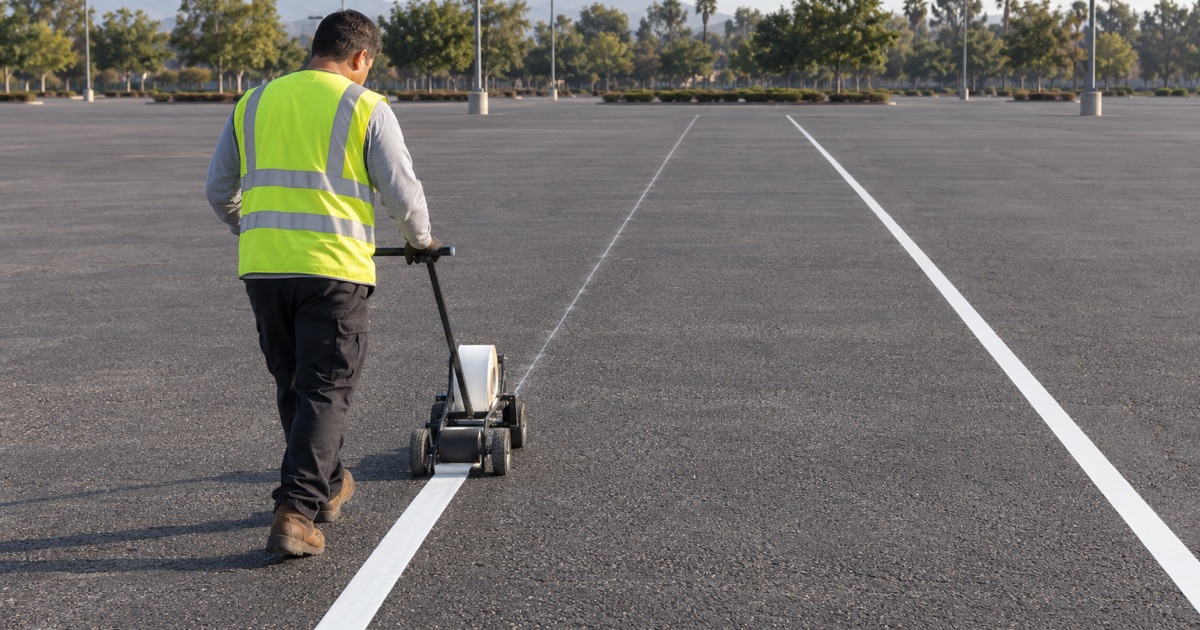
A regional field cannot be re-marked in a session, so the work is a program spanning many nights with the field sectioned so trading is never interrupted. Each area returns to service before the following one is opened up, and the whole order is fixed before the first night rather than decided as the program goes along. On a field this size an improvised sequence strands areas that cannot be reached.
We also decide in advance what a lost session does to the rest of the sequence, because on a program of this length the time is not recoverable later and a crew standing on an occupied section costs exactly what a working crew costs. Building slack into the order is cheaper than rebuilding the order.
Reading Wear Across an Enormous Area
Traffic on a regional field is spread rather than funneled, so wear arrives comparatively evenly and most of the pavement reaches the end of its life at about the same time. That favors a planned full re-mark on a known interval over patching areas as somebody notices them, since patching a field that is uniformly worn produces a property with two ages of marking and no obvious logic to either.
Our faded-line inspections produce a dated interval for the next round rather than a judgment on how the field looks today, and the survey record covers it area by area. On a property this size that breakdown is what makes staging across two budget years possible instead of theoretical.
Wayfinding Over Distance
On a field where a shopper may be several hundred yards from their vehicle, aisle identification and directional control matter more than the stall lines. Somebody who cannot locate their car is a customer service problem well before they become a marking one, and they take that experience to be about the property rather than about its paint.
Arcadia contains a series of adjacent parks including the Santa Anita Park racetrack, the Los Angeles County Arboretum and Botanic Garden, and Arcadia County Park, and property near attractions of that kind carries a high proportion of drivers who have never been there before. Habit is no help to them, so the marking is carrying the whole navigation task.
Directing Traffic Across a Large Field
Crossings That Work Over Distance
The walk from the outer rows of a field this size crosses several drive aisles before it reaches a building, and marking that as a continuous route rather than as a set of unrelated crossings changes how people move across it. Pedestrians follow a path they can see, and on open ground with no other cue there is nothing else for them to follow. A route that disappears halfway sends everybody back to improvising.
Crossings themselves are laid to the California MUTCD patterns rather than fitted to whatever gap the layout left, because a crossing that is only approximately right creates a false expectation about who is going to stop. On a field where drivers are travelling further and faster between aisles than they would on a small lot, that expectation matters more. We would rather move a crossing than compress one.
Speed on Long Aisles
Long uninterrupted aisles invite speed, and a large field has more of them than any other property type we work on. The marking can do some of that work through aisle width and through how the crossings are placed, but on the longest runs it usually needs help from physical devices as well.
Speed bumps and wheel stops belong in the layout rather than being added afterward where somebody complained, because a device placed reactively tends to sit where it is least useful and most often struck. We set them against the drawing and specify the anchoring for the surface they are going into. A device that works loose is a hazard rather than a control, and on a field carrying event traffic it will be found quickly.
Drawing It Before It Is Multiplied
Every decision taken on a field of this size is repeated across an enormous amount of pavement before anybody stands on the finished result, which raises the value of settling the layout on paper considerably above what it is worth on a small lot. A stall dimension chosen carelessly is not one mistake, it is several thousand.
We draw the layout and get it approved before anything is laid, and on a large property that drawing is also the document the program is sequenced from. It tells everybody which areas come out in which order and what is going back into service when, which is not a conversation that can be usefully had on the night. The drawing outlives the job.
Seasonal and Overflow Marking
Ground Used a Few Days a Year
Overflow areas take very little traffic for most of the year and then absorb everything the main field cannot, which makes them easy to under-specify and easy to forget. A faded overflow layout is discovered on the one day it was needed, by which point nothing can be done about it and everybody is directing traffic by hand.
We survey overflow ground with the main field rather than as an afterthought, and we are honest about which parts of it are worth marking at all. Where a surface is unbound or genuinely marginal, paint on it is money spent on something that will not last a season, and marking the paved boundary clearly is the more useful answer.
Accessible Parking When the Field Is Full
Accessible stalls on event property have to survive a peak day, which means being legible enough that a field under pressure does not simply absorb them. Placing them correctly on a quiet afternoon is not the test that matters, because the day they are needed most is the day every other space on the property has already gone.
Every job here includes measuring the accessible stalls, their aisles and the associated signage against current code, asked for or not. The provision the federal 2010 ADA Standards call for scales with the total number of spaces, and on a field of this size that total is routinely wrong because nobody has counted the whole property in one pass.
Devices, Signage and What Is Underneath
Large fields carry a great deal of signage installed at different times by different people, and on event property it accumulates faster than anywhere else. Reviewing what is standing usually beats adding to it, and signs go up alongside the marking so a stall and the restriction above it come from a single specification.
Wheel stops and bollards get replaced on visits the property has already booked rather than through separate trips. Surface condition goes into the same report, including where sealcoating would be laying money over asphalt that needs repairing first, because on a field this size that decision is worth getting right before it is multiplied across the whole property.
- 20+ Years Striping Commercial Lots
- ADA Layouts Checked to Chapter 11B
- Night & Weekend Scheduling











