
Glendale Parking Lot Striping provides parking lot striping in Artesia, CA for a specialty retail district whose lots are small, dense and worked far harder than their size suggests. The parking here was mostly laid out parcel by parcel alongside the buildings it serves, rather than planned as a field, and that history shows up in every survey we do.
The commercial draw is the distinguishing fact. Retail in this district pulls destination traffic, meaning people who chose to travel here for particular shops rather than stopping while passing. Destination visitors arrive with an intention, park once, and stay longer than a convenience shopper would, which changes both how full the lots get and how long they stay that way.
Small parcels carrying destination demand is an unforgiving combination for a marking plan. There is no slack anywhere: no spare row to sacrifice for a wider aisle, no overflow to absorb a peak, and no window when a lot is comfortably empty. Every decision has to be made against what the site already cannot afford to lose.
Small Lots in a Specialty Retail District
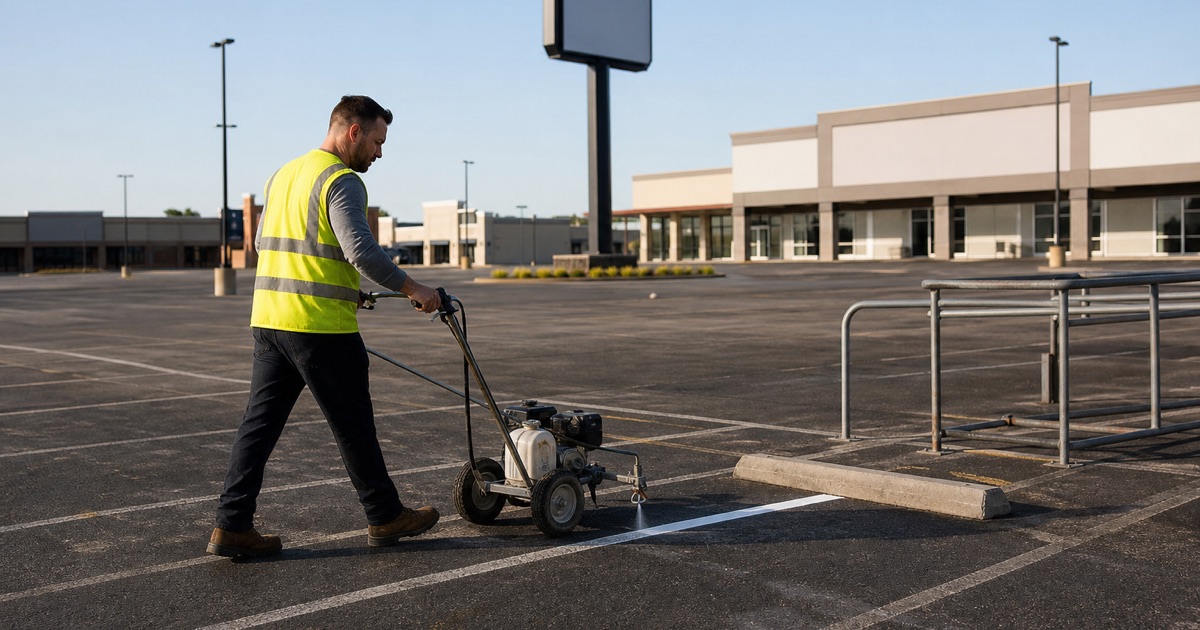
Every Square Foot Is Already Spoken For
On a compact site the layout is a set of competing claims rather than a plan with room in it. Aisle width, stall depth, the turning circle at the closed end of a row and the accessible stalls all draw from the same limited area, and improving one takes directly from another. There is no version where everything gets what it wants.
We work through those trade-offs explicitly rather than letting the tightest constraint decide by default. An owner who understands that a wider aisle costs a specific number of stalls can make that call properly. An owner who simply receives a finished lot discovers the cost later and has no way to weigh it.
Drawing It Before Painting It
The layout gets drawn and approved before any paint reaches the asphalt, and on a small lot that step earns its keep more clearly than anywhere else. A stall count settled on paper is a decision, while a stall count discovered after the lines are down is an argument with a removal bill attached. Tight sites leave no room to absorb a mistake.
The drawing also lets us test a layout against the vehicles that actually use it. A delivery van reversing into a rear service area or a car turning at the closed end of a row will either fit or it will not, and that is answerable from a plan. Finding out on the night is considerably more expensive.
Frontages Shared Between Neighbors
Parcels this size frequently share access, so a driver crossing between two lots may never notice they have changed ownership. What they do notice is a change in stall width, angle or line quality halfway down a row. Neighboring owners marking their own areas on their own schedules is how a district ends up looking neglected while every individual lot is technically maintained.
Where owners are willing, we mark adjoining areas to one agreed specification even when the work and the invoices stay separate. That keeps a shared frontage legible without anybody giving up control of their own property. It is a conversation worth having once, because the alternative repeats at every cycle.
Looking for parking lot striping closer to Signal Hill? See Parking Lot Striping Services in Signal Hill.
Destination Traffic and the Weekend Peak
A Lot Sized for Tuesday, Loaded on Saturday
Destination retail concentrates its demand. Weekday trade sits well within what these lots hold, and the weekend peak fills them completely and then some, which means the layout is judged almost entirely on how it performs at its busiest. A design that works comfortably on a quiet afternoon tells you very little.
We survey with that in mind and ask to see a site loaded before recommending changes. Where a lot fails at peak, the failure is usually circulation rather than count: drivers who cannot see the far row, or a queue that forms because nobody can turn around. Those are marking problems and they are fixable without losing stalls.
Queueing at the Entrance
When a compact lot is full, arriving drivers stop somewhere, and the only question is whether they stop on the property or on the road behind them. Marking a decision point inside the entrance, with enough space for a car to clear the street before choosing, is worth more here than almost any other single change. A queue that backs out of a driveway affects everybody.
Where the geometry genuinely will not allow it, saying so is more useful than marking something optimistic. Some sites need a different entry arrangement rather than better paint on the current one. We would rather report that than paint a solution that only works when the lot is half empty.
Wear That Arrives in Bursts
Peaky demand wears markings unevenly across the week, and the wear concentrates where cars maneuver under pressure: entry throats, aisle ends, and the stalls nearest the doors. Those areas reach the end of their life well ahead of the rest of the field. Reading a small lot by its worst area is what produces a defensible interval.
A faded-line inspection here produces a dated interval for the next round instead of an opinion about how the lot looks today, and the photographs cover it area by area rather than picking out one flattering row. That lets an owner budget the next cycle instead of waiting for a complaint to set the timing for them.
Making a Compact Lot Work Harder
Angle, Aisle Width and What They Cost Each Other
Parking angle is the lever with the most travel on a small site. Angled stalls need a narrower aisle and are easier to enter, but they force one-way circulation and generally cost total capacity, while ninety-degree stalls hold more cars and demand more room to maneuver into. Neither is correct in the abstract.
The right answer depends on whether the site’s real constraint is count or flow, which is a question about how the lot behaves at peak rather than about its dimensions. We work that out before proposing a change. A layout switched from one to the other for its own sake usually trades a known problem for an unfamiliar one.
Removing the Old Plan Before Drawing a New One
Small lots re-marked repeatedly over decades carry the residue of every previous plan, and painting over an old line only postpones it: the covered marking surfaces again as the new coat wears. On a tight site where the layout has genuinely changed, those ghost lines are not cosmetic. They give a driver two contradictory answers in the space where there is barely room for one.
Obsolete markings are taken off instead of painted over, and we flag it in the quote when the removal carries real cost. It is the item most often left out of a cheaper bid, and its absence is invisible on the day the work is finished. It becomes visible about a year later.
Working Around a Lot That Cannot Spare a Row
A district lot with no overflow cannot be closed, so the work is sectioned and part of the site stays open throughout. On a small property that means smaller sections and more of them, which is slower than closing a lot outright and is the only approach the tenants can actually live with.
Night and weekend scheduling is the default rather than a premium option, and the sequence is agreed before the crew arrives rather than negotiated on site. We also plan for the possibility of losing a night, because a compact lot leaves no room to improvise a recovery. Knowing what happens then is part of the schedule, not an afterthought.
Marking Beyond the Stalls
Accessible Stalls on a Tight Site
Accessible parking is the requirement least amenable to compromise on a constrained lot, and it is also the one owners most often hope to solve by moving it somewhere convenient. It has to sit on a genuine route to the entrance it serves. Every job includes a code check on the accessible stalls, the aisles beside them and the signs, not only the jobs where somebody thinks to ask.
Because the federal 2010 ADA Standards tie the requirement to how many spaces exist altogether, a single layout decision on a small lot can shift it. Adding stalls to a compact site can quietly change what it owes. We recount at the drawing stage so that arrives as information rather than as a surprise.
Crossings and Pedestrian Routes
Destination shoppers walk between lots and shops far more than convenience shoppers do, which puts people in drive aisles that were laid out with only cars in mind. Marking a continuous route from the parking to the frontage changes behavior more reliably than a sign does. People follow a path they can see.
Crossings are laid to the California MUTCD patterns rather than improvised to fit the space available, because a crossing that is nearly right reads as decorative. Where a site is too tight for a compliant crossing in the obvious place, the honest answer is to move it rather than to shrink it.
Signage, Stops and Surface
Small lots collect signage from every tenant who ever wanted some, and the result contradicts itself more often than it informs. Going through what is standing is usually worth more than adding to it, and signs go in while the marking crew is there so a bay and the sign controlling it come from one specification.
Wheel stops and bollards get the same treatment, replaced during a visit already scheduled rather than through a separate call-out. We note what the surface is doing while we are on it, and the report says so, including where sealcoating would be spending on asphalt that ought to be repaired first. Marking a failing surface just buries the problem under fresh paint.
- 20+ Years Striping Commercial Lots
- ADA Layouts Checked to Chapter 11B
- Night & Weekend Scheduling











