
Glendale Parking Lot Striping provides parking lot striping in Burbank, CA for two property types that barely resemble each other: production and media campuses on one side, and large-format retail centers on the other. Almost everything we do in this city falls into one or the other, and the two ask for opposite things from a marking plan.
A production campus is effectively a private town with controlled access, and its parking is dominated by long-stay employee use punctuated by irregular surges. A big-box retail center is the reverse, with constant short-stay turnover across a very large field of stalls. Getting the specification right means treating them as separate problems rather than applying a single approach to both because they sit in the same city.
Burbank is long established as a center of the media industry, and the practical consequence for us is scheduling. A campus with a shooting schedule and a retail center with trading hours both have windows we have to work around, and neither will move them for a striping contractor. Sequencing is negotiated before the quote is finalized rather than after.
Studio and Production Campus Lots
Access Control Changes the Layout
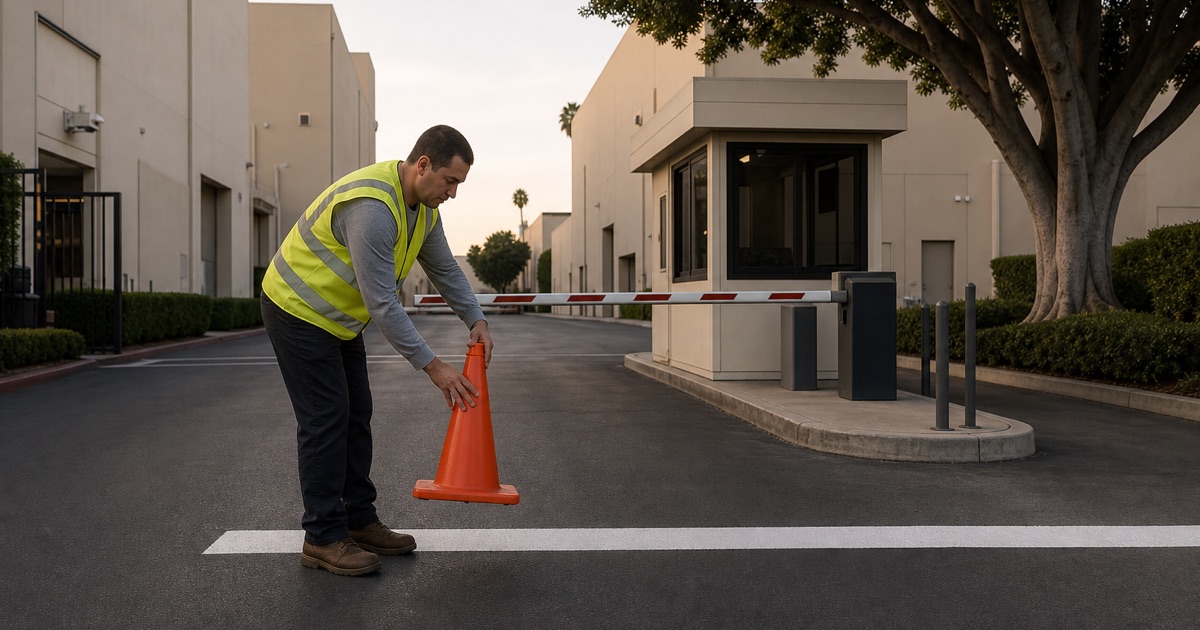
Campus parking sits behind gates, and the marking has to work with that rather than against it: queueing space at the gate, a decision point for a driver who has been turned away, and separation between arriving traffic and the internal circulation beyond. A gate backing up onto a public street is a marking problem before it is a security one.
We look at the queue length the entry can actually absorb and mark to it, because the alternative is a layout that works perfectly once a car is inside and fails at the point everybody experiences first. That approach also gives security staff a defined place to direct people rather than an improvised one, which matters when the person being turned away is already blocking the lane behind them.
Employee Fields and Shift Patterns
Long-stay employee parking tolerates a tighter stall than customer parking does, which on a constrained campus can recover a meaningful number of spaces. What it does not tolerate is ambiguity at shift change, when a large number of vehicles try to leave through the same route at once.
Marking the exit routes and their merge points properly matters more here than anywhere else on the property. A field that empties smoothly is largely a question of how legible the circulation is under pressure rather than how many stalls it holds. Drivers who know where they are going merge; drivers who are guessing stop, and one stopped car at a merge point holds up everything behind it.
Temporary and Reserved Marking
Production work generates short-term parking needs that the permanent layout was never designed for, and marking those areas conventionally leaves a campus carrying obsolete lines within months. Where a requirement is genuinely temporary, it should be marked as temporary and removed properly afterward.
We are candid about this because the alternative is what we most often find: a campus with three generations of reserved-bay markings visible at once, none of which anybody currently honors. Removing old markings rather than painting over them is the only approach that keeps a campus legible over time.
Looking for parking lot striping closer to Los Feliz? See Los Feliz Parking Lot Striping.
Big-Box Retail Centers
A Very Large Field of Stalls
A large retail center is one continuous field rather than a set of small lots, and the marking problem is legibility across distance. Aisle identification, directional control and clear crossings do more for a shopper’s experience than the stall lines themselves. Somebody who cannot find their car is a customer service problem long before they become a marking one.
Wear across a field like this is even rather than concentrated, which means the whole area reaches the end of its service life at roughly the same time. That argues for a planned full re-mark on a known cycle rather than patching sections as they fade.
Cart Traffic and Stall Width
Anywhere shoppers arrive with carts, stall width stops being a capacity question and becomes a damage question. Doors open wider, carts get parked between vehicles, and a stall specified for an employee lot generates complaints and paint transfer within a season.
Corral placement belongs in the same conversation, because a corral sited badly costs stalls and pushes carts into the drive aisle. We mark corral footprints as part of the layout rather than leaving them to migrate across a season. A corral that has drifted ten feet from where it was intended is doing damage to the stalls around it.
Pedestrian Routes Across the Field
The walk from the far end of a large field to the entrance crosses several drive aisles, and marking that route as a continuous path rather than a series of unrelated crossings changes how people behave. Crossings are laid to the state traffic control manual’s patterns rather than improvised.
Accessible stalls sit at the head of that route, and the longer the field the more their placement matters. We check accessible stalls, aisles and signage on every visit as a matter of course rather than only when asked.
Working Around the Schedule
Night Work Is the Default
Neither property type here can give up parking during its operating hours, so the work happens at night and across weekends. We section the site so part of it stays available throughout rather than closing a field or a campus outright.
On a campus the constraint is often narrower than the trading hours of a retail site, because production schedules run long and change late. We plan for that rather than treating a promised window as guaranteed, and we agree in advance what happens if a night is lost. A crew standing idle at a gate costs the same as a crew working.
Sequencing Across a Large Property
Both property types here are large enough that a full re-mark spans several nights, so the order matters. Each area is returned to service before the next comes out, and the sequence is written into the schedule rather than settled on the night.
On a campus that sequence often has to bend around a production calendar that changes late, so we build slack into it rather than assuming every promised window will actually be free. A plan with no give in it is a plan that gets abandoned on the second night.
Documentation That Survives a Handover
Facilities and operations staff on campuses and retail centers both turn over, and a marking scheme that lives in one person’s memory becomes guesswork at the next cycle. We hand over a plan showing what was marked, in what material, with photographs by area and a written interval for the next round.
On a multi-property owner that record also makes the next quote comparable, because the specification is written down rather than reconstructed from what the pavement currently looks like. It is the cheapest part of the job and the part clients thank us for years later.
Signage, Devices and the Rest of the Property
Signage on a Controlled Campus
Gated property carries a great deal of signage, and it accumulates rather than being designed: direction, restriction, reserved allocation and accessible stall signs installed by different people at different times. Auditing it is usually more valuable than adding to it.
We supply and set signage on the same visit as the marking, which keeps a stall and the sign that governs it specified together. Where a sign is faded, non-compliant or simply contradicts another one twenty feet away, we say so rather than leaving it standing. Contradictory signage is worse than none, because it gives anyone challenged on the property something to point at.
Wheel Stops, Bollards and Protection
Large fields carry wheel stops at building frontages and bollards protecting entrances, equipment enclosures and columns, and both fail quietly. A concrete stop cracks, a bollard is struck and never replaced, and nobody logs either because they are not anybody’s specific responsibility.
We replace damaged units during visits already scheduled for marking, which costs a fraction of sending someone out for them. Anchors are matched to the substrate rather than to whatever is quickest, because a stop that works loose is a trip hazard rather than a guide. Asphalt takes driven spikes and concrete needs drilled anchors, and reusing one approach on the other is the most common reason these fail.
Surface Condition Under the Paint
Retail fields and campus lots in this city are frequently older than the tenancy using them, and a re-mark is a poor investment on pavement that is failing. We record surface condition as part of the survey rather than treating it as somebody else’s problem.
Where an area needs repair before it is worth marking, we say so and sequence it accordingly, even when that means a smaller invoice this year. Paint laid over a surface that is breaking up disappears with the asphalt beneath it.
- 20+ Years Striping Commercial Lots
- ADA Layouts Checked to Chapter 11B
- Night & Weekend Scheduling











