
Glendale Parking Lot Striping provides parking lot striping in Commerce, CA for the warehouse and distribution property that makes up most of the city’s building stock. Striping a distribution site is a different discipline from marking a retail lot, and the difference starts with the vehicle: everything about the geometry is set by a tractor-trailer rather than a car.
Most of what we mark here is not stalls at all. It is truck court, dock apron, trailer parking, staging and the circulation between them, plus the pedestrian routes that have to cross all of it safely. Those markings take a beating that a car park never sees, because a loaded trailer turning tight against a dock face abrades the surface in a way passenger tires do not, and they need specifying accordingly rather than by habit.
The city is served by the Long Beach and Santa Ana freeways and by rail, and the freight movement that comes with that access is continuous. Very few sites here can hand us an empty yard at any hour, so almost all of our work is sequenced around live operations rather than scheduled into a closure. That constraint shapes the quote as much as the marking itself, and we would rather plan around it openly than discover it on the first night.
Truck Courts and Dock Aprons
The Apron Takes the Hardest Wear
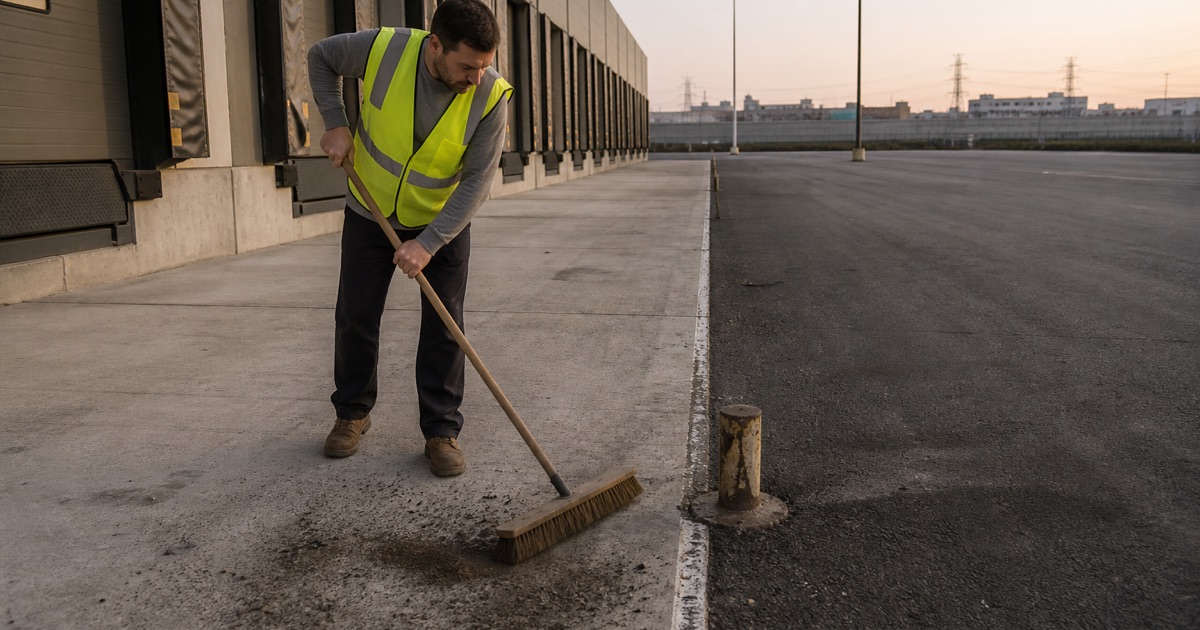
The strip of pavement directly in front of a dock face absorbs repeated tight turning under full load, and it is where markings fail first on any distribution site. Standard traffic paint in that zone is a short-term investment, which is why we specify a heavier build or thermoplastic where the budget allows.
Treating the apron as a different specification from the rest of the yard is usually cheaper over a cycle than marking the whole site identically and re-marking the apron twice as often. It also keeps the rest of the yard on a predictable interval rather than dragging the whole site back for the sake of one strip of pavement.
Depth Governs Everything
Truck court depth determines whether a trailer can square up to a dock without swinging into the drive aisle behind it, and marking has to reflect the depth the site actually has rather than an ideal. Where a court is tight, the markings guide the approach rather than pretending there is room for a comfortable one.
We measure and set out against the real dimensions before painting, because a court marked to a standard the site cannot accommodate teaches drivers to ignore the lines. Once that habit sets in on a yard it carries over to the markings that genuinely matter, including the pedestrian crossings.
Dock Positions and Numbering
Numbering dock doors and marking their approach positions removes a surprising amount of daily friction, particularly where a facility runs appointment-based receiving. Clear numbering also gives yard staff and drivers a shared vocabulary for a position.
Numbers are laid to a size that stays legible from a cab at an angle, in daylight and under yard lighting, rather than to a size that looks right on a drawing, and they are placed where a positioned trailer does not cover them. Painting a number where the trailer parks over it is a surprisingly common mistake and it wastes the entire exercise.
Looking for parking lot striping closer to Huntington Park? See Huntington Park Parking Lot Striping.
Trailer and Yard Marking
Trailer Stalls Are Not Parking Stalls
Trailer storage positions are laid out to the length of the equipment, with room to drop and retrieve without shunting the neighbors. Marked properly, a yard holds more trailers with less manoeuvring; marked as though they were oversized car stalls, it holds fewer and creates conflict at every retrieval.
The difference shows up in gate time rather than in appearance, which is why it is worth measuring the equipment on site rather than working from a standard drawing. A yard that stores containers as well as trailers usually needs two position sizes rather than one compromise between them.
Yard Circulation and Turning
Directional marking through a yard matters more than in a car park because a tractor-trailer cannot correct a wrong turn easily. Circulation is marked one way wherever the geometry allows it, and turning paths are set against the swept path of the equipment on site rather than a generic radius.
Where a yard has both employee parking and freight movement, separating the two is the single most valuable marking decision available, and it is usually achievable without losing a stall. Staff walking between a car and a door across an active trailer path is the risk that most often exists without anyone having decided to accept it.
Keeping People Out of the Freight Path
Pedestrian routes across a working yard need to be continuous, marked at full length, and routed to cross traffic at as few points as possible. A walkway that stops halfway leaves people improvising exactly where the equipment is heaviest.
Crossings are marked to the state traffic control manual’s patterns rather than by eye, and we mark them where the route genuinely needs to cross rather than where it is convenient to paint. A crossing placed for the painter’s convenience gets ignored, which is worse than not marking one at all.
Outlet-Scale Retail Fields
A Different Job on the Same Streets
The city also carries an outlet-scale retail destination, and marking a field of that size has almost nothing in common with the yards around it. Stall count, circulation, cart traffic and pedestrian crossings all come back into play.
Working both property types in one city means we can sequence a retail field and a distribution yard in the same visit window rather than mobilizing twice. For an owner holding both kinds of asset locally that is a straightforward saving, and it keeps one specification and one set of records across the portfolio.
Volume Changes the Cycle
A high-turnover retail field wears its markings faster than an office lot but differently from a dock apron: the wear is spread evenly across thousands of stalls rather than concentrated in one strip. That distinction changes what we recommend and when.
Even wear across a large field means the whole area reaches the end of its service life at roughly the same time, so the sensible plan is a scheduled full re-mark rather than patching sections as they fade. Budgeting for that in advance is considerably cheaper than reacting to it.
Accessible Provision in a Large Field
The larger the field, the longer the accessible route from a stall to the entrance, and the more the placement of accessible parking matters. We check accessible stalls, aisles and signage on every visit as a matter of course, and on a large field the route is what most often needs attention.
Obstructions are the usual problem rather than the stalls themselves: a wheel stop set slightly wrong, a sign post in the aisle, or a cart corral that has migrated into the route. Those are all things we can move on the same visit, which makes finding them worth the walk.
Working Around Continuous Operations
Sequencing Instead of Closing
Almost no facility here can stop, so we work section by section, aisle by aisle and dock by dock. The sequence is agreed in writing before we start, so a shift supervisor knows which positions are out and when they come back.
On appointment-based receiving operations that plan has to survive contact with the day’s schedule, so we build slack into it rather than assuming every window will be free when we reach it. A sequence that has to be renegotiated in the middle of a night shift costs more than the one that allowed for a delay.
Cure Time in a Working Yard
The constraint is never application, it is cure. On a yard running continuously, that means marking areas in an order that lets each one return to service before the next is taken out, which takes planning rather than speed.
Material choice affects this directly, because a fast-return product in a critical position can be worth more to a facility than a longer-lived one that closes a dock for an extra hour. That is a trade-off we put to the client rather than deciding quietly.
Reporting for a Facilities Budget
Findings are itemized by area and photographed by section, so a facilities manager can take a real document to a budget conversation rather than a single line. On a site this size, knowing which quarter of the yard needs attention first is most of the value, because it turns an unaffordable whole-site number into a sequence that fits a budget cycle.
We also give a written interval for each zone rather than one figure for the property, because an apron and a storage area genuinely do not come round at the same time. Treating them as one number is what produces a yard that is half worn out and half freshly marked.
- 20+ Years Striping Commercial Lots
- ADA Layouts Checked to Chapter 11B
- Night & Weekend Scheduling











