
Glendale Parking Lot Striping carries out commercial crack sealing across Glendale, CA and surrounding cities including Burbank, Van Nuys, Atwater Village, Eagle Rock and La Crescenta-Montrose. Crack sealing is the cheapest meaningful thing you can do for a parking lot, and skipping it is how an inexpensive surface problem turns into an expensive base problem.
A crack is not primarily a cosmetic defect. It is a path for water to reach the aggregate base beneath the asphalt, and once water is getting into the base every other failure mode accelerates: the base softens, traffic works the weakened area, and what was a hairline opening becomes a pothole or an area of alligator cracking that no surface treatment will repair.
The specification matters more here than most contractors admit, because sealant is graded by the climate it was formulated for. A product that performs correctly through a freezing winter behaves badly on a hot lot in this basin, and that mismatch is one of the more common imports from national supplier catalogs.
Reading the Cracks
Not Every Crack Is Sealed
Cracks are sealed when they are wide enough to admit water and narrow enough that a sealant can hold. Very fine hairline cracking is usually better addressed with a surface coating, and openings past a certain width need routing or patching rather than filling.
Alligator cracking is the exception that catches people out. It looks like the most urgent crack problem on the lot and it is not a crack problem at all, because the interlocking pattern indicates the base has failed underneath. Sealing it wastes material and buys nothing, and a contractor who quotes to seal an alligatored area either has not looked closely or is hoping you will not.
Where the Water Is Getting In
Cracks concentrate along construction joints, at the edges of previous patches, around drainage structures and wherever the lot flexes. Reading the pattern tells you what is happening structurally rather than just where to put sealant, which is why we walk and record the lot before quoting. Cracking that follows the line of an old trench tells a different story from cracking radiating out of a low spot, and the two call for different work.
Routing and Cleaning
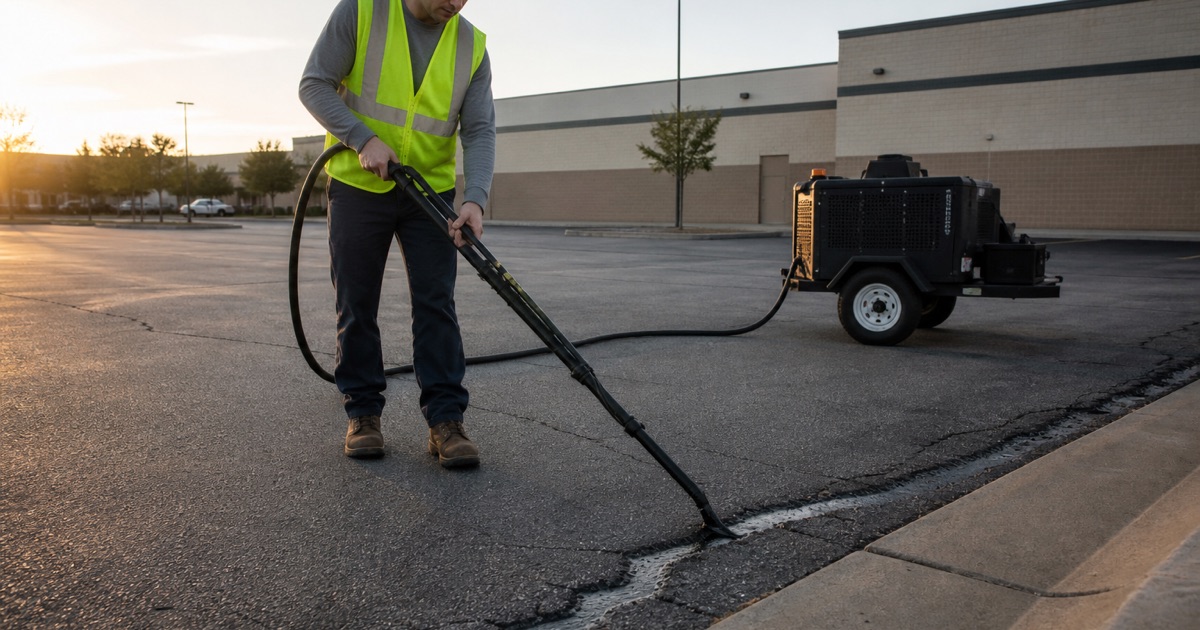
A crack that is simply filled without preparation traps dust, moisture and vegetation, and the sealant releases from the walls within a season. Wider cracks are routed to create a clean reservoir with sound faces for the sealant to bond to, and every crack is blown out and dried before material goes in.
Vegetation is removed at the root rather than cut at the surface. Anything left alive will push straight back through, and a plant growing through a fresh seal is the most visible possible advertisement that the preparation was skipped.
Specifying the Right Sealant
Climate Grade Is Not Optional
Hot-applied crack sealants are classified by the climate they are designed for, and the moderate-climate class is the correct one for this region. Cold-climate grades are formulated to stay flexible at temperatures we never see, which makes them too soft here: they bleed under summer surface temperatures and track onto tires and into buildings.
At least one major manufacturer states plainly on its own data sheet that its cold-weather product is not recommended for parking lots. We specify to the climate and to the application rather than to whatever is on the truck.
Hot-Applied Against Cold-Pour
Hot-applied rubberized sealant is melted and installed at temperature, bonds well to prepared crack faces and stays flexible through thermal movement, which matters because asphalt moves with surface temperature every day of the year. Cold-pour materials are simpler to apply and generally less durable, which makes them reasonable for small isolated areas and a false economy across a whole lot.
Finishing the Joint
Sealant can be left slightly recessed, flush, or banded over the crack, and the choice affects both appearance and how the seal wears under traffic. Overbanding sheds water well and is more visible; a flush finish is tidier and less forgiving of preparation errors.
We choose the finish with the client rather than defaulting, because on a high-visibility retail frontage appearance genuinely matters and on a service yard it does not. Overbanding on a customer-facing entrance drive is usually the wrong call even though it performs slightly better.
Where It Fits in the Maintenance Cycle
Before Sealcoating, Always
Crack sealing precedes any coating. Sealer applied over an open crack drapes into it rather than bridging it and splits again at the first movement, so a lot sealed without crack work first has paid for a coating with a built-in failure. It is also the sequence error that is hardest to correct afterward, because the evidence is now under the coating.
Before Striping, Too
Markings laid across an unsealed crack fail along that line first, and a stall line broken by a widening crack is the thing a property manager notices before anything else. Doing the sequence correctly means the markings age evenly instead of failing in patches, which is what makes a re-stripe interval predictable enough to budget against.
Timing and Access
Crack sealing is fast and needs relatively little of the lot at once, which makes it the easiest maintenance item to run without disrupting a property. We section the work and schedule around trading hours, and on most commercial sites the sealant is trafficable quickly enough that nothing has to close for long. It is often the item worth doing first when a budget will not stretch to everything a survey found.
- 20+ Years Striping Commercial Lots
- ADA Layouts Checked to Chapter 11B
- Night & Weekend Scheduling