
Glendale Parking Lot Striping carries out parking lot striping in Echo Park, CA on blocks where essentially every commercial lot is smaller than the use it serves. Parcels here were subdivided long before parking was a consideration, and the buildings take almost all of the ground, so what remains for vehicles is a remainder rather than a provision.
That makes stall count the central question rather than an output. On a generous site a layout is a matter of arranging spaces sensibly; on an undersized one it is a sequence of trades, where aisle width, stall depth, the turning area and the accessible parking are all drawing from the same shortage. Something has to give and the only question is what. An undersized lot does not have a correct layout waiting to be found, it has a set of defensible compromises and a much larger set of indefensible ones.
We would rather that be decided than discovered. The layout is drawn and signed off before anything is laid down, so an owner sees what a wider aisle costs in spaces and what a tighter stall costs in complaints. Those trades are legitimate to make either way, and they are not legitimate to make by accident.
Getting Stalls Out of an Undersized Lot
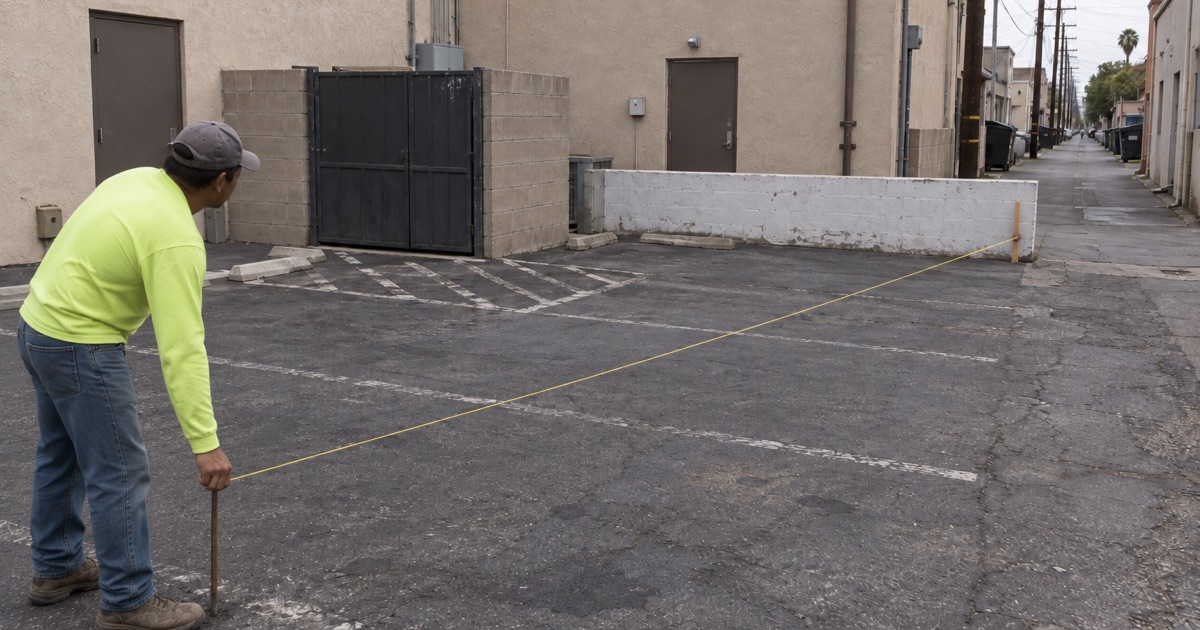
Angle Is the Lever With the Most Travel
Parking angle changes the arithmetic more than anything else available on a small lot. Angled stalls need a narrower aisle and are much easier to enter, at the cost of committing the lot to one-way circulation and usually reducing the total. Perpendicular stalls hold more vehicles and demand room these parcels rarely have.
Neither is right in the abstract, and the deciding question is whether a particular lot fails on capacity or on flow. That is answered by watching it full rather than by measuring it empty. A lot with enough spaces that jams anyway is telling you the count was never the constraint, and adding stalls to it will make the situation worse rather than better.
Compact Stalls and Who They Actually Suit
A mixed compact and standard stall arrangement can add real capacity where the user base supports it, and it fails badly where it does not. Long-stay users tolerate a tighter space, and customers arriving with a full car and a door to open in a hurry do not.
We ask what the parking is genuinely for before proposing a mix, because a compact stall in the wrong place generates paint transfer and complaints inside a season and returns the capacity it gained. Where a mix is right, marking it clearly enough that drivers self-select is the whole trick. An unmarked compact row is just a row of stalls people are annoyed by, and the capacity it was supposed to deliver comes straight back out in complaints and door damage.
Tandem and Attended Arrangements
Where a lot genuinely cannot hold what its use requires, a tandem or attended arrangement puts more vehicles on the same ground at the cost of everybody’s freedom to leave when they choose. It is a legitimate answer for a staff lot and a poor one for customer parking, because the people it inconveniences have to be people who can be asked to accept the inconvenience.
If a site is going to work that way, marking the lanes turns the arrangement into something the property owns rather than something the current staff remember. It also makes the site’s real capacity a number rather than an opinion, and it keeps the stacking out of the areas that have to stay clear whatever the pressure.
Looking for parking lot striping closer to Hollywood? See Hollywood Parking Lot Striping.
Dense Mixed-Use Blocks
Residents and Businesses on the Same Ground
Mixed-use buildings put dwellings above commercial frontage and give both the same undersized lot behind. Residents park overnight and leave in the morning, customers arrive during the day, and the same spaces are wanted by different people at different hours.
The boundary between allocated and open parking is therefore the most consequential line on the property, and it only works while it stays readable. We specify it for the years an allocation is expected to last without attention, because a bay number worn to a smudge is an argument with nothing to settle it. Long-life material costs more on the day and considerably less across the period the scheme is meant to survive.
Layouts That Outlive Their Reason
Small commercial parcels change use often, and each change leaves something behind: a loading zone for a business that closed, bays allocated under a previous letting, a crossing to a door that has since been walled up. On a lot this size the accumulated instructions crowd out the current ones, and a driver reads the pavement as a whole rather than working out which layer applies to them.
Anything obsolete comes off rather than getting painted over, since a buried line works its way back as the top coat thins and leaves a driver two contradictory answers in a space that barely fits one. We say at quote stage when that removal is a real share of the price, because it is the item a cheaper bid quietly leaves out.
Getting In and Out of a Small Lot
Access to these parcels is usually one narrow opening onto a busy street, which makes the entrance the point where a small lot either functions or does not. A car waiting to turn in, a car waiting to leave and somebody walking across the same gap all want the same few feet at the same moment. Nothing about the layout inside the lot helps with that, so it has to be resolved at the opening itself.
We mark to what the opening can genuinely absorb, including the cases where the honest answer is very little. Giving an arriving driver somewhere defined to pause inside the property keeps the queue off the sidewalk. Echo Park sits in the central region of Los Angeles and its commercial blocks were laid out for a street that carried far less traffic than they do now.
Event-Driven Overflow
Demand That Arrives From Somewhere Else
The neighborhood is centered on Echo Park Lake and is known for its concentration of independent businesses, which means these lots regularly absorb demand generated by something happening nearby rather than by the property itself. An undersized lot has no capacity to give away and no way to distinguish one driver from another. That is a marking and signage problem rather than a design one, because the layout cannot tell who anybody is.
Marking and signage are what make a restriction enforceable, and they only function while they agree with each other and remain readable. Signs are supplied and set while the marking crew is there, so a stall and the rule attached to it come from one specification rather than from two visits a year apart.
The Areas That Must Stay Clear
On a lot with no slack, the space reserved for something else is the space a driver under pressure will take. Emergency access, a route to a building exit and the accessible stalls with their aisles all look like available parking at exactly the moment the lot is full.
We hatch those so they read as excluded rather than merely unoccupied, and specify them to still read that way after a season of traffic. A restriction worn back into a suggestion is worse than none, because the person enforcing it has nothing left to point at.
Compliance on a Parcel With No Slack
Accessible parking is the requirement least able to absorb a compromise on an undersized lot, and it is the one owners most often hope to satisfy with whichever corner is easiest to spare. It has to sit on a genuine route to the entrance it serves.
Stalls, aisles and signage are held against current code on every visit here as standard rather than on request. Because the federal 2010 ADA Standards derive the requirement from the total provision, adding spaces to a small lot can quietly change what the property owes, which is a thing to establish on the drawing rather than after the paint.
Condition and What It Is Worth Marking
Reading a Small Lot Honestly
Wear on a small heavily used lot concentrates at the entrance and the first turning area rather than spreading, so those are the places a survey should read. The open pavement between them reports very little and looks reassuring.
A faded-line inspection here produces a dated interval for the next round rather than a verdict on today’s appearance, with photographs covering the lot area by area. On a property this size that is a short document, and it is still what turns the next round into something an owner can plan instead of react to.
Saying When the Asphalt Comes First
Pavement on these blocks is generally older than the businesses using it and has been opened and patched by whoever needed to get underneath. We put condition into the report rather than treating it as somebody else’s concern.
That includes the cases where sealcoating would be money laid over asphalt that has to be repaired first, which occasionally costs us the larger invoice this year. Marking a surface that is coming apart is spending twice, and on a lot with nothing to spare the second bill lands sooner than an owner expects.
- 20+ Years Striping Commercial Lots
- ADA Layouts Checked to Chapter 11B
- Night & Weekend Scheduling











