
Glendale Parking Lot Striping marks fire lanes on commercial property across Glendale, CA and surrounding cities including Burbank, Pasadena, Culver City, Alhambra and Monrovia. Fire lane marking looks like the simplest work on a lot and is the item where local requirements vary most, which makes it the one most often got wrong by a contractor working from a template.
The state fire code requires fire apparatus access roads to be marked, and then leaves a good deal of the detail to the authority having jurisdiction. Each fire department applies its own amendments, so the sign dimensions, the lettering, the spacing and even the wording can differ between two cities that share a boundary. We confirm the requirement for your specific address before painting rather than assuming.
There is also a distinction worth being clear about, because it is easy to get backwards. A fire lane restriction in California is carried by a painted curb and by signage. Red pavement is not permitted as a traffic control device, so the phrase everyone uses does not describe painting the driving surface red.
What the Marking Has to Do
Access Routes Are Designated, Not Chosen
A fire apparatus access road is a designated route with required width and clearance, and it is designated by the fire authority rather than by the property. Marking it is about making an existing designation visible and enforceable, which is why the first step is establishing where the route actually runs on your site.
Where a property has changed since the route was set, through a new building, a re-layout or added landscaping, the route and its marking may both need revisiting. That is a conversation with the fire authority rather than something a striping contractor can decide, and we will say so rather than painting over the question. Marking a route that has moved is worse than leaving it unmarked, because it directs apparatus down a path that no longer works.
Curb Painting and Lettering
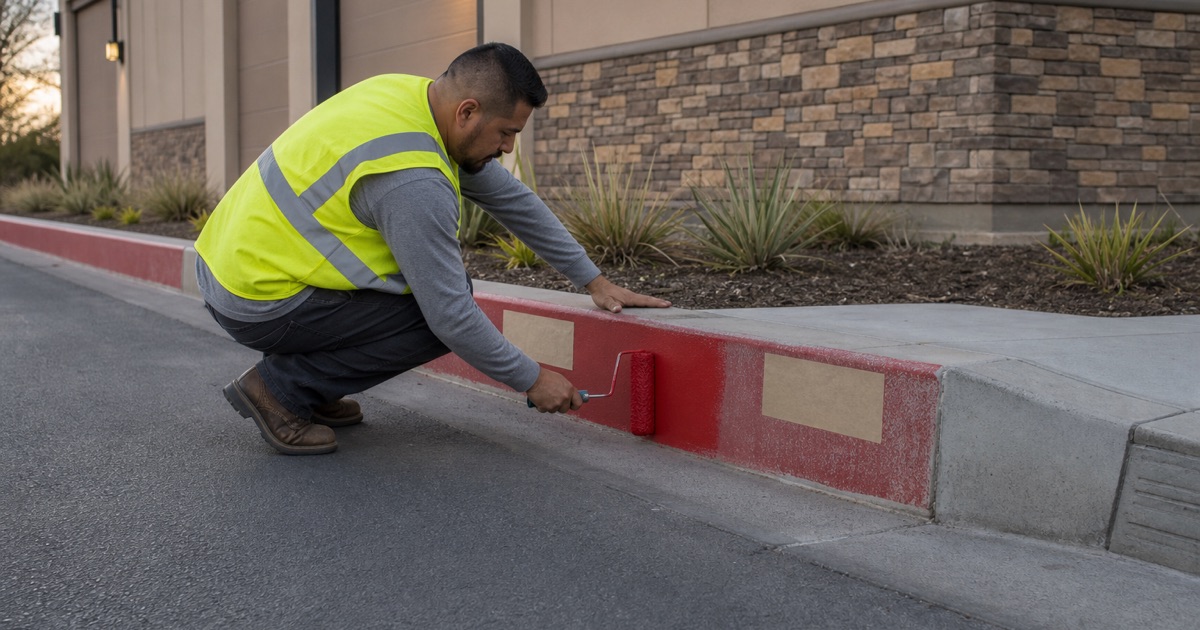
The restriction is marked with a painted curb in the statutory color and with lettering, typically a stencil legend repeated along the run at an interval the local department specifies. Letter height, color and spacing are all specification items rather than matters of preference.
We mask and cut the lettering rather than freehanding it, because a legend that is uneven or the wrong height is a defect that is obvious in a photograph and expensive to argue about. Consistent spacing along the run matters for the same reason.
Signage Completes It
Curb marking alone is generally not sufficient. Signs at the specified size, height and spacing are what make the restriction legible to a driver approaching, and some jurisdictions specify sign wording and dimensions precisely. We supply and install signage as part of the same visit rather than leaving a marked curb without the signs that support it. A painted curb with no signage is the most common half-finished fire lane we are called out to complete.
Enforceability and Statutory Color
Curb Colors Are Defined by Statute
California vehicle law assigns specific meanings to red, yellow, white, green and blue curbs, so painting a curb is a statement about what the law permits at that spot. A curb painted the wrong color either says nothing enforceable or says something the property did not intend.
That is also why we will decline to paint a curb a color a client has asked for when it would misstate the restriction, and explain what the correct marking would be instead.
An Unmarked Restriction Cannot Be Enforced
A fire lane that is faded, unmarked or incorrectly marked is a fire lane that a vehicle can be parked in with no practical consequence. For a property manager the marking is not a formality; it is the mechanism that allows a vehicle to be removed.
This is the same logic that applies to accessible stalls, and it is why we treat marking and enforceability as one question rather than two. A restriction nobody can act on is decoration with legal wording printed on it.
Keeping It Legible
Red curb fades under ultraviolet exposure faster than most lot markings, because it sits in full sun on a vertical face and takes physical contact from tires and street sweepers. It needs refreshing on a shorter cycle than stall lines, and we build that into the interval we give a property.
Working With the Authority Having Jurisdiction
Confirming Before Painting
We confirm the requirement with the fire department covering your address before any marking is laid. Across the cities we serve, that means several separate departments with separate amendments, and one large county authority covering contract cities, all with their own expectations.
The cost of a phone call before the work is negligible. The cost of marking an entire frontage to the wrong specification and being asked to redo it is not, and removal of incorrect curb marking is more disruptive than the original job.
Devices in the Access Route
What may be installed in a fire apparatus access route is constrained, which affects speed bumps, humps, cushions, bollards and gates. A device that is unremarkable on an internal aisle can be unacceptable within a designated route.
Because we install those devices as well as marking the lanes, we can resolve the conflict at the design stage rather than discovering it during an inspection. It is one of the practical advantages of not splitting the work across separate contractors.
Working Around the Property
Fire lane work concentrates along frontages and entrances, which are the most disruptive places on a commercial site to close during trading. We phase it and schedule at night and on weekends, and we keep the marked run continuous rather than leaving a property with half a legible restriction. A partially marked fire lane invites exactly the parking behavior the marking exists to stop.
- 20+ Years Striping Commercial Lots
- ADA Layouts Checked to Chapter 11B
- Night & Weekend Scheduling