
Glendale Parking Lot Striping provides parking lot striping in Highland Park, CA for retail corridors built as continuous storefront with the parking pushed to the back. There is almost no front-of-building parking anywhere along these streets, because the buildings meet the sidewalk directly and always have.
Every lot we work on here is therefore a rear lot, reached from an alley or a narrow side approach rather than from the commercial street the business fronts. That single fact governs the layout more than the size of the parcel does. The approach decides which direction cars can circulate, which in turn decides which way the stalls can face and how many of them there are.
Highland Park was one of the first subdivisions of Los Angeles, and the block pattern it was laid out on has outlasted several generations of commercial use. The alleys behind these corridors were drawn for deliveries and for household access, not for customer parking, and every lot behind them is working within dimensions that were settled long before anyone needed them to hold cars.
Small Rear Lots Behind Storefronts
Working Within a Parcel That Was Never Meant for This
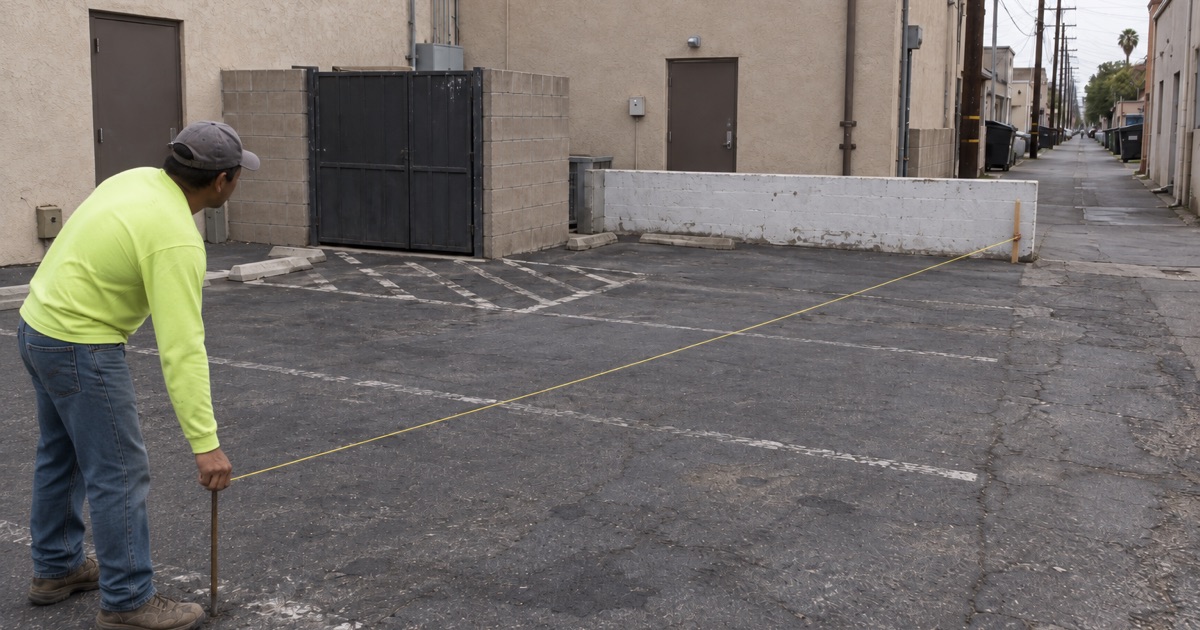
A rear lot on a subdivided commercial block is usually the leftover space behind a building rather than an area anyone designed for parking. It is narrow, irregular, and bounded by walls on two or three sides, which leaves very little scope for a layout that is not partly dictated by the shape.
We settle that layout on a drawing before any paint reaches the asphalt, because on a parcel this constrained the difference between a workable plan and an unworkable one is a matter of feet. A stall count agreed on paper is a decision. The same count discovered after the lines are down is an argument with a removal bill behind it.
Turning, Reversing and the Closed End
The closed end of a narrow rear lot is where most of these properties actually fail. A driver who reaches it and finds no space has to reverse the length of the lot, and if anybody has arrived behind them in the meantime, neither car can move. That is a layout problem rather than a driver problem.
Where the parcel allows it, we mark a turning area and protect it, even at the cost of a stall, because one recovered space is worth less than a lot that jams at its busiest hour. Where it genuinely does not allow one, we say so and mark the entry to keep the number of cars committed to the lot within what it can release.
Stall Angle Against a Narrow Aisle
Angle is the lever that matters most on a narrow rear lot. Angled stalls need less aisle width and are far easier to enter, though they commit the lot to one-way circulation and usually reduce the total. Perpendicular stalls hold more cars and need room to maneuver that these parcels frequently do not have.
The right choice depends on whether the binding constraint is the count or the width, and that is answerable from the parcel rather than from preference. We work it out before proposing anything, because a layout switched from one arrangement to the other for its own sake tends to trade a familiar problem for a new one.
Looking for parking lot striping closer to Altadena? See Parking Lot Striping Services in Altadena.
Alley Access and Circulation
One Way In, One Way Out
An alley behind a commercial corridor is rarely wide enough for two cars to pass comfortably, and it is carrying deliveries, refuse collection and customer traffic on the same surface. In practice these lots run one-way whether or not anyone marked them, and drivers work out the convention by trial and error.
Making the direction explicit at the entry is the highest-value marking on many of these properties. It costs nothing in stalls and removes the confrontation that happens when two cars meet with nowhere to go. We mark the direction where a driver reads it before committing, not after they are already in the alley.
Sharing the Approach With Everything Else
The alley is a service route first and a parking approach second. A delivery vehicle stopped across the lot entrance blocks the property completely for as long as it is there, and there is no alternative way in. That is a fact about the block rather than something marking can eliminate.
What marking can do is keep the approach itself clear of anything that makes the situation worse, and give a driver a defined place to wait inside the property rather than in the alley. Hatching the area in front of a gate or an entrance tells drivers something that a bare patch of asphalt never will.
Where the Lot Meets the Sidewalk
A customer parking behind a corridor walks out through a gap between buildings or around a corner to reach the storefront. That route crosses the alley, sometimes the lot’s own drive aisle, and eventually a public sidewalk, and on most of these properties none of it is marked as a pedestrian route at all.
We mark the walk as a continuous path rather than as unrelated crossings, and crossings themselves are laid to the California MUTCD patterns rather than fitted into whatever width is left. People follow a route they can see. A driver in a narrow alley benefits just as much from knowing where to expect them.
Mixed-Use Infill Parking
Residents and Customers on the Same Pavement
A great deal of the newer building stock along these corridors is mixed use, with dwellings above and commercial at street level, and the parking behind serves both. Residents park overnight and leave in the morning, while customers arrive during trading hours, so the same stalls are wanted by different people at different times.
Marking is how that separation gets communicated, through clear designation of which stalls are allocated and which are open, and it only works if the designation is legible after a couple of years of wear. We specify the material with that in mind. A restriction that has faded to a suggestion generates more disputes than no restriction at all.
Layouts That Change With the Tenancy
Infill property changes use more often than purpose-built retail does, and each change leaves marks on the pavement: a loading zone for a business that closed, allocated bays from a previous letting arrangement, a crossing that used to lead to a door that has been walled up. Within a few cycles the lot carries several plans at once.
We remove obsolete markings rather than paint over them, because a covered line comes back through the new coat as it wears. On a small rear lot that resurfacing is not cosmetic. Two contradictory lines in a space that barely fits one is how a driver ends up parked somewhere nobody intended.
Keeping the Restriction Enforceable
Allocated parking behind a mixed-use building only works if somebody can act on it, and that depends on the marking and the signage agreeing with each other. A stall marked as reserved with no sign, or a sign referring to a numbering scheme the pavement no longer shows, gives an owner nothing to point at.
We handle the stall and the sign that governs it on the same visit for exactly that reason. Where the existing signage contradicts itself, which on a property that has changed hands is common, auditing what is standing is more useful than adding another sign to the argument.
Devices, Compliance and the Surface
Accessible Stalls in a Constrained Rear Lot
Accessible parking is the hardest requirement to place on a narrow rear parcel and the one owners most often hope to satisfy with the most convenient corner. It has to sit on a real route to the entrance it serves, which for a rear lot means the route out to the frontage rather than to the nearest wall.
Code compliance on the accessible stalls, the aisles and the signs is part of every visit here as standard, not an extra somebody has to request. Since the federal 2010 ADA Standards derive that requirement from the total number of spaces, a small change to a small lot’s layout can quietly change the obligation.
Stops, Bollards and Wall Protection
Rear lots are full of things worth protecting: gas meters, electrical enclosures, the corner of a building that every delivery driver clips. Bollards get installed to protect them, then struck and never replaced, because nobody has been made responsible for noticing.
We replace damaged units during a visit already scheduled for marking, which costs a fraction of a separate call-out, and we set wheel stops against the drawing rather than against the marks left by the previous layout. A stop protecting something under a plan that no longer applies is doing nothing except taking up room.
Reporting the Pavement Honestly
The asphalt behind these buildings is often the oldest surface on the property, patched by whoever needed to open it and never fully resurfaced. Marking it is straightforward and marking it is sometimes the wrong recommendation.
Surface condition is recorded on every survey and reported as found, including the cases where sealcoating would be spending on pavement that has to be repaired first. That occasionally means a smaller invoice this year. It is better than paint that disappears with the asphalt underneath it well before the interval has run.
- 20+ Years Striping Commercial Lots
- ADA Layouts Checked to Chapter 11B
- Night & Weekend Scheduling











