
Glendale Parking Lot Striping delivers parking lot striping in Hollywood, CA for hotel and venue property whose parking is busiest long after most commercial lots have emptied. The buildings here are hospitality, entertainment and visitor accommodation, and their demand curve is close to the inverse of an office park’s.
That inversion matters more than it sounds. Every judgment about a marking scheme — how legible a line is, whether a driver can find an aisle, how visible a crossing is to somebody turning across it — is normally made in daylight by people walking a lot at midday. On these properties almost none of the use happens under those conditions.
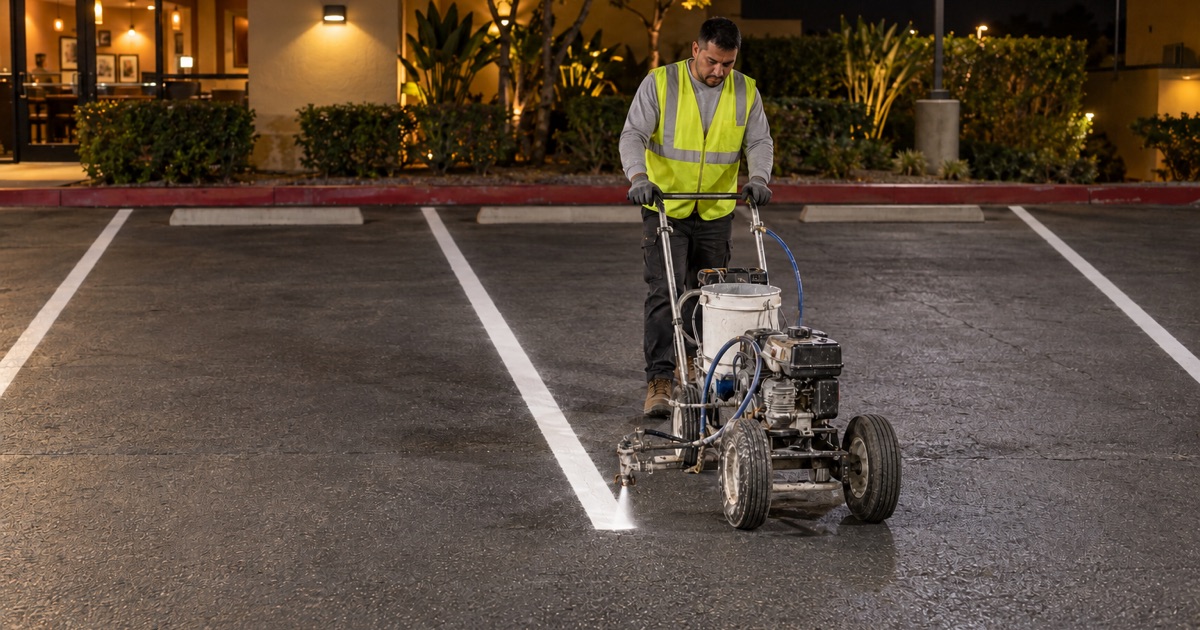
We assess and specify against the hours the lot actually works. That means walking a property after dark before proposing anything, and it means treating the optical performance of the marking as a design decision rather than as a property of whatever paint is on the truck. A line that reads well at noon and disappears at eleven has failed at its job.
Hotel and Venue Parking
Guests Who Arrive Once and Stay
Hotel parking has an unusual profile: a guest arrives, parks, and leaves the vehicle for a day or several, which means the field turns over slowly but the arrivals cluster into a narrow evening window. The lot is under its heaviest load precisely when it is hardest to read.
Marking has to make the arrival straightforward for somebody who has never seen the property, because that is nearly every driver using it. Clear direction from the entrance to the available parking, and a legible route from the parking back to the building, are worth considerably more here than an extra row of stalls at the far end.
Venue Lots and the Shape of an Event
A venue lot does the opposite of a hotel lot. It fills almost entirely within an hour before an event and empties within about the same time afterward, which means the layout is judged entirely on how it behaves under two brief periods of extreme load. Everything else about its performance is close to irrelevant.
Filling and emptying are different problems and the marking usually only addresses the first. We look hard at the departure case, because a field that fills in an orderly way and then jams on the way out has failed at the moment everyone remembers. Marking the exit routes and their merge points is where that gets fixed.
Keeping Emergency Access Clear Under Load
Property that fills to capacity in a short period has a predictable failure, which is that the aisles intended to stay clear become the last available parking. Fire lane marking on a venue or hotel property is not decorative and it stops working the moment it has faded past the point where anybody will act on it.
California Vehicle Code Section 22500.1 governs parking in a marked fire lane, and California Fire Code Section 503.3 covers how apparatus access is marked. A fire lane is a painted curb rather than a colored patch of pavement, since red pavement is not a permitted traffic control device, and we mark it that way rather than the way it is sometimes asked for.
Looking for parking lot striping closer to North Hollywood? See Parking Lot Striping in North Hollywood.
What Marking Has to Do After Dark
Retroreflectivity Is the Specification
In daylight a marking is read by contrast. At night it is read by light returning to the driver from their own headlights, and that depends on the glass beads in or on the marking rather than on the paint alone. Two lines that look identical at midday can perform completely differently at the hour these lots are full.
We name the paint and the application in the quote for that reason, including the bead specification where it matters, because a cheap job and a durable one look the same on the day they are finished and quite different six months later at eleven at night. On a night-use property this is the difference the client is actually buying.
Where the Lighting Is Doing the Work and Where It Is Not
Lot lighting is uneven on almost every property we survey, and it degrades quietly as lamps fail one at a time with nobody logging it. The marking has to work hardest exactly where the lighting has given up, which is usually the far corners and the perimeter aisles.
We record lighting conditions as part of the night survey and report what we find, even though the lamps are not our repair. An owner who knows which areas their marking is carrying alone can either fix the lighting or specify the marking accordingly. Being told about it is more useful than a quote that quietly assumes the lot is lit.
Crossings People Will Actually Be Seen On
A pedestrian crossing a drive aisle in an unlit lot at night is relying entirely on the driver looking in the right place. Marking crossings to the California MUTCD patterns rather than improvising them is what makes a driver read the situation as a crossing rather than as an unusual patch of paint.
Placement matters as much as the pattern. A crossing sited where an arriving driver is still looking for a parking space is worse used than one placed where their attention has already shifted to the building. We walk both routes at night before deciding, which is not something a daytime survey can tell you.
Visitors Who Have Never Been Here Before
Legibility for a Driver With No Local Knowledge
Hollywood’s name is synonymous with the film industry, and the visitor traffic that comes with that reputation means a large share of the drivers on these lots are unfamiliar with the property, the street it sits on and often the region. They cannot fall back on habit for any part of the trip.
A layout that regular users navigate from memory will expose every ambiguity in it when the drivers are all new. Directional marking, aisle identification and an obvious route back to the entrance stop being refinements and become the main thing the marking is for. We design for the driver who has no idea where anything is.
Rideshare and Drop-Off Movements
A substantial number of arrivals at hospitality property now come by rideshare rather than by car, which puts vehicles stopping briefly at points the lot was never laid out to accommodate. Left unmarked, that activity settles wherever it is most convenient for the driver, which is normally across an entrance or in a drive aisle.
Marking a defined stopping area moves it somewhere chosen rather than somewhere found, and it keeps the movement out of the routes that need to stay clear. The boundary and the restriction both have to be legible for it to work, and it has to be visible at night, which rules out the faint painted rectangle these areas usually get.
Coaches, Oversized Vehicles and Where They Fit
Visitor property attracts vehicles the stall layout never contemplated, from coaches to oversized rentals, and they end up occupying whatever space is physically large enough regardless of what it was marked for. That is a layout question rather than a discipline question.
Where a property genuinely receives these vehicles, marking a suitable area is cheaper than losing three stalls to one of them every evening. Where it does not, saying so honestly is better than marking an optimistic bay that will be used as ordinary parking within a month. Either answer is more useful than leaving it to work itself out.
Valet Operations and the Rest of the Property
Valet That Appears Only for an Event
Venue and hotel property here often runs valet for a premiere or a private event and self-parking the rest of the week, which means the same field carries two different systems on different nights. The valet arrangement is set up by whoever is running it that evening, using whatever the layout happens to allow.
Marking the areas a valet operation may use, and the areas it may not, turns that into a property standard rather than a decision improvised on the night by somebody who will not be there next month. It also settles in advance what happens to the accessible stalls and to emergency access on the busiest nights, which is exactly when an improvised arrangement takes them.
Accessible Stalls on a Visitor Property
Accessible parking on hospitality property has to sit on the route to the entrance guests use, not the one that happens to be convenient to lay out. On a venue site it also has to survive an event, which means it needs to be legible enough that a full lot does not simply absorb it.
The federal 2010 ADA Standards pin the count owed to the total space provision, and hospitality sites miscount easily because their parking is usually spread across more than one area. We recount rather than inherit a number, and we check the stalls, their aisles and the signage on every visit.
Signage, Devices and Working Around the Trade
Signage on a night property is read under artificial light and is frequently blocked by parked vehicles at the hours it matters most, so placement and condition both count for more than they would on a daytime lot. Signage goes in alongside the marking, and any damaged wheel stop or bollard is dealt with while the crew is already on the property instead of through a separate call-out.
The work itself has to fit around a trade that peaks in the evening and a housekeeping cycle that runs in the morning, which leaves a narrower window than most commercial property offers. We section the site so part of it stays open throughout, agree the sequence before the crew arrives, and settle in advance what happens if a session is lost. On a property with no spare capacity, that plan is worth more than speed.
- 20+ Years Striping Commercial Lots
- ADA Layouts Checked to Chapter 11B
- Night & Weekend Scheduling











