
Glendale Parking Lot Striping delivers parking lot striping in Monrovia, CA for a city that carries two distinct commercial districts with a considerable distance between them. One is a modern business park with light manufacturing alongside it, and the other is an older downtown of small lots on a historic street grid.
They are not variations on one problem. A business park lot is large, purpose-built, professionally managed and maintained on a schedule somebody is accountable for. A downtown lot is small, irregular, frequently shared and maintained when the fading becomes impossible to ignore. The specification, the scheduling and even the person we deal with are different in each case.
Monrovia is the fourth-oldest general-law city in Los Angeles County, sitting in the foothills of the San Gabriel Mountains, and that age is visible in the downtown parcels. The business park is a much later addition, and the contrast between the two is most of what defines our work in this city.
Business Park Lots
Long-Stay Parking and What It Allows
A business park lot fills in the morning, holds all day and empties in the evening, with users who park in the same area repeatedly and know it well. That tolerance is worth taking advantage of, since long-stay parking accepts a tighter stall than customer parking and on a constrained site can recover a meaningful number of spaces.
What it does not tolerate is ambiguity at the end of the day, when a large number of vehicles leave through the same route within a short period. Marking the exit routes and their merge points properly matters more here than the stall count does. A field that empties smoothly is a question of legibility under pressure rather than capacity.
Tenant Signage and Reserved Bays
Multi-tenant business park property accumulates allocation over time: reserved bays for a tenant that has since grown or left, visitor spaces added when somebody complained, and signage installed by whoever needed it. Nobody looks at the whole scheme, so it drifts.
We go through what is standing rather than adding to it, and signs are supplied and fitted while the marking crew is on the property, keeping a bay and its restriction on a single specification. A reserved bay with no sign, or a sign referring to a numbering scheme the pavement no longer shows, gives a manager nothing to act on.
Maintenance Somebody Is Accountable For
Business park property is usually managed by somebody whose job includes maintaining it, which makes a written interval genuinely useful rather than an unwelcome document. A date, a scope and a reason can be put in a budget, whereas a photograph of a faded aisle only confirms that the lot is already overdue.
We organize survey photographs by area rather than reducing a property to one representative image, which lets a manager stage the work across areas or across budget years. It also means the next inspection is a comparison against a record rather than a fresh opinion from whoever happens to walk the site.
Looking for parking lot striping closer to South Gate? See Parking Lot Striping in South Gate.
Historic Downtown Parking
Small Lots on an Old Grid
Downtown parcels were laid out long before anybody was allocating land for parking, so the lots that exist there are small, irregular and hemmed in, often reached through an opening that was a service entrance first. There is no spare depth to work with and no scope to change the access.
We settle the layout on a drawing before any paint reaches the asphalt, because at this scale the difference between a workable plan and an unworkable one is a matter of feet. A count agreed on paper is a decision; the same count discovered after the lines are down is a removal job and an awkward conversation.
Shared Lots and Adjoining Owners
Downtown lots frequently share a driveway or a drive aisle with the parcel next door, an arrangement the two owners understand and no customer notices. What a driver does notice is the stall width changing halfway along a run and the line quality changing at an invisible boundary.
Where owners will agree to it, neighboring areas can be held to a single written specification with each of them still buying and scheduling independently, so nobody hands over control of their own property. In a small district that consistency is the single most visible improvement available, and it costs nothing beyond agreeing it once.
Keeping a Downtown Trading
A downtown district trades across a long day and has no overflow within walking distance, so its lots cannot be closed. The work gets cut into sections so some parking survives at every point, runs at night and over weekends, and puts each area back into use before opening the next.
A small parcel needs the job cut into many brief stages, and their order counts for more than the pace. It is fixed ahead of the first night together with the fallback, because a lot this size gives nobody room to improvise a recovery.
Light Manufacturing Property
Yards That Are Working Pavement
Light manufacturing property uses its pavement for staging, movement and storage rather than for parking, and the marking is defining where those happen. The areas that must stay clear are a larger part of the job than the stall lines, and they are the ones that fail first under real use.
We plan them with the people running the operation rather than around them, since a scheme devised without them is ignored within a fortnight. Hatching is used deliberately and sparingly, because an area hatched for no visible reason teaches everybody on the site to disregard the ones that matter.
Where People Walk Across a Working Site
Employee parking on a manufacturing site is normally adjacent to ground used by equipment and delivery vehicles, and the walk from a car to a door crosses it. That crossing is where the risk concentrates and it is very often the least marked surface on the property.
We mark a defined route from the parking to the entrance, laid to the California MUTCD crossing patterns where it crosses a vehicle path. It is inexpensive against the exposure it removes and it is the item most often missing, because the yard was marked for the operation and the walk was never on anybody’s list.
Surfaces Under Load
Manufacturing pavement fails locally rather than evenly, breaking up where vehicles turn under load and at gate throats rather than fading uniformly across a field. Marking follows the surface, so a re-mark laid over ground that is coming apart is money spent twice.
Condition is recorded area by area and reported as found, including where sealcoating would put money over asphalt that ought to be repaired first. That sometimes costs us the larger invoice this year and it remains the right report, because fresh paint disappears with the asphalt beneath it.
Two Districts, Two Buying Cycles
The business park buys this work on a maintenance schedule and the downtown buys it when somebody finally objects to the state of the lines, which means the same city produces two entirely different conversations. Neither is unreasonable given who is paying and what they are accountable for.
What helps in both cases is a written interval attached to a scope, because it converts an open-ended request into something a manager can approve or a small owner can save toward. A property with a date on its next round is considerably more likely to get one than a property carrying a general sense of being overdue.
Compliance, Devices and Records
Accessible Parking in Both Districts
A business park lot and a downtown parcel present opposite versions of the same requirement. On the first the constraint is keeping accessible stalls on the route people actually walk across a large field, and on the second it is finding a compliant location at all on a parcel with nothing to spare.
Accessible stalls, aisles and signage go through a current-code check on every job, not just the jobs where the question gets asked. Required provision under the federal 2010 ADA Standards is a proportion of the total, and on a small lot even a modest layout change moves it. We recount at the drawing stage rather than inheriting a figure.
Devices Nobody Has Logged
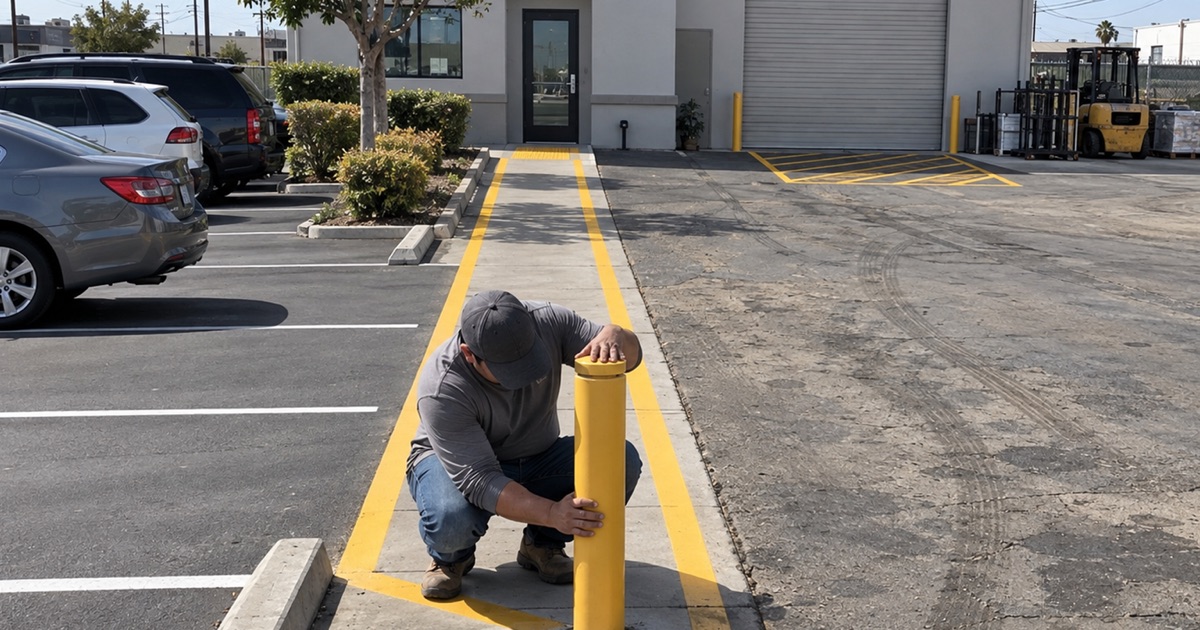
Wheel stops crack, bollards get struck, and on property without dedicated facilities staff neither is recorded because neither is anybody’s defined responsibility. Damaged units get swapped out on a visit already booked for marking, at a fraction of what a dedicated trip costs.
Placement is worth checking at the same time, since a stop protecting something under a layout that no longer applies is doing nothing except occupying space. We set them against the current drawing rather than against the marks left by whatever was there before.
Removing What Came Before
Property in both districts has been re-marked repeatedly, and painting over an old line only defers it: the covered marking surfaces again as the new coat wears. On a small downtown lot where the layout has genuinely changed, those ghost lines give a driver two contradictory answers in a space that barely fits one.
Markings that no longer apply come off rather than getting painted over, and we say at quote stage when the removal is a meaningful share of the number. It is the item most often left out of a cheaper bid, and its absence is invisible on the day the work is finished and obvious about a year later.
- 20+ Years Striping Commercial Lots
- ADA Layouts Checked to Chapter 11B
- Night & Weekend Scheduling











