
Glendale Parking Lot Striping handles parking lot striping in Montebello, CA for a town center retail district and the light industrial parcels that sit directly behind and beside it. The two land uses are not in separate parts of the city here. They share blocks, they share access roads, and in several places they share a boundary with nothing but a fence line between them.
That adjacency is the distinguishing feature of the work. A retail lot backing onto a working yard has a different set of problems from one surrounded by more retail: delivery vehicles arriving through customer parking, a shared access road serving both uses, and a rear boundary that neither owner treats as their frontage.
Montebello is considered part of both the Gateway Cities and the San Gabriel Valley Cities, and that in-between position shows in the building stock. The commercial core is a conventional town center and the parcels behind it are working property, and a lot of what we do here happens at the seam between the two.
Town Center Retail Lots
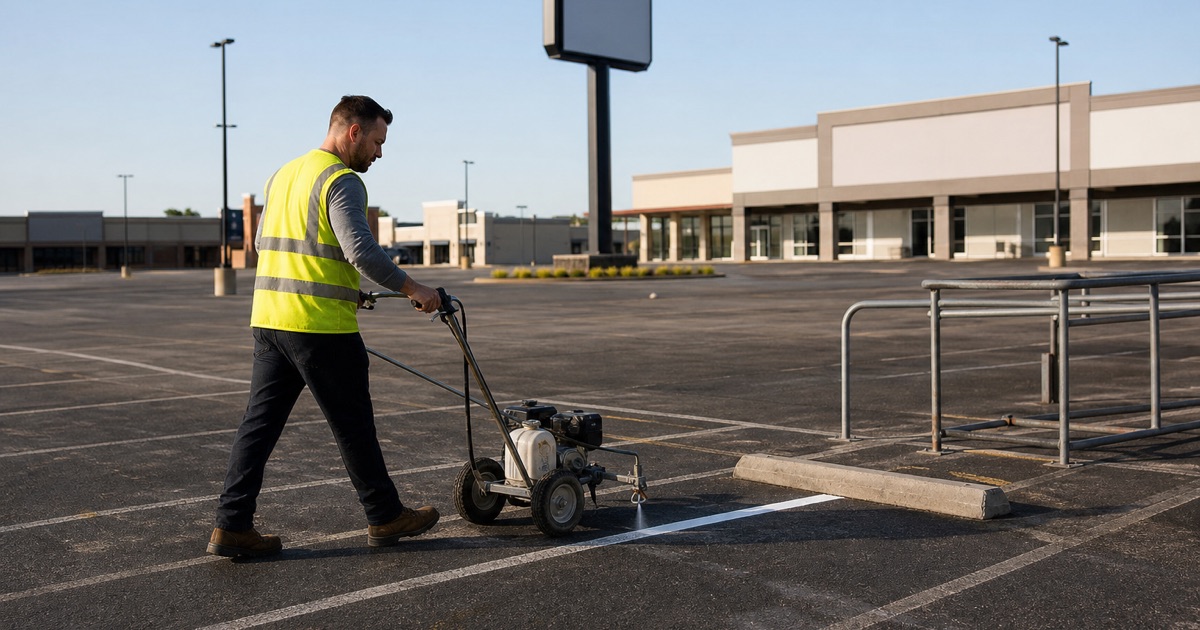
Parking for a District, Not a Building
A town center lot serves the street it sits on rather than only the business that owns it, because customers park once and walk to several destinations. Demand takes no notice of the property line, and owners regularly find their parking full of people shopping further along the block.
Marking cannot allocate what the ownership pattern does not, but it can make a lot hold what it is capable of holding and empty without jamming. We settle both on a drawing before any paint reaches the asphalt. A count agreed on paper is a decision, and a count discovered after the lines are down is a removal job.
Consistency Along a Retail Frontage
Adjacent lots marked by different contractors on different dates drift apart until a frontage that is individually maintained collectively looks tired. Stall widths change halfway along a run and line quality changes at a boundary no customer can see. Every owner has paid and the street still looks neglected.
Where owners will agree to it, neighboring lots can be held to a single written specification even while each pays for and schedules its own work. Nobody gives up control of their property or their timing. What changes is that the geometry, the material and the interval match across the boundary rather than announcing it.
Trading Hours With No Quiet Window
A town center trades through a long day and into the evening, and there is no overflow within walking distance to absorb a closure. Work is staged in sections so no lot ever loses all its parking at once, running at night and over weekends, and nothing new opens up until the previous area is back in use.
Smaller lots need the work cut finer, into more stages of shorter duration, and getting their order right is worth more than getting through them quickly. The order is settled ahead of the first night, along with what happens if one is lost.
Looking for parking lot striping closer to Commerce? See Parking Lot Striping Services in Commerce.
Light Industrial Parcels
Rear Yards Doing Working Duty
A light industrial parcel behind a retail block is working pavement rather than parking: staging, storage, vehicle movement and the routes that have to stay clear between them. Stall lines are the smallest part of the marking and the areas that must remain open are the largest.
We plan those with the people running the operation rather than around them, because a yard marked without them produces a scheme that is ignored by the second week. Hatching is used sparingly and only where there is a real consequence, since an area hatched for no visible reason teaches everybody to disregard the ones that matter.
Deliveries That Arrive Through Somebody Else’s Parking
The recurring problem at this seam is a delivery vehicle reaching a rear yard by way of a retail lot, because that is the only practical approach. The vehicle is large, the driver is unfamiliar, and the route was never marked as a route at all.
Marking a defined path through the parking, and keeping stalls out of the swept path a large vehicle genuinely needs, resolves most of it. It costs a few spaces and prevents a daily conflict that both owners have been absorbing. Finding out what the vehicles actually need is a survey question rather than an assumption.
Staff Parking Against a Working Yard
Light industrial sites put employee parking adjacent to ground used by equipment and delivery vehicles, and the walk from a car to a building crosses it. That boundary is where the risk concentrates and it is very often the least marked surface on the property.
We mark a defined pedestrian route from the parking to the entrance, laid to the California MUTCD crossing patterns where it crosses a vehicle path. Long-stay employee parking also tolerates a tighter stall than customer parking, which on a constrained parcel can recover a useful number of spaces without generating complaints.
Mixed Commercial Blocks
Shared Access Roads Serving Two Uses
A single access road commonly serves a retail frontage and the working parcels behind it, carrying shoppers and delivery vehicles in the same lane at the same time. Nobody owns the whole road and each owner marks their own frontage, which is how a shared route ends up with three conventions along its length.
We treat that road as one system when laying anything out, because a change that improves one property can push a queue onto the next. Marking the direction and the priorities consistently along it is worth more than any individual lot improvement, and it needs the owners to agree once rather than repeatedly.
The Boundary Nobody Treats as Frontage
The line between a retail lot and a working parcel is the back of both properties, which means neither owner treats it as their responsibility. Markings fade there first, devices get damaged and never replaced, and the area quietly becomes wherever things end up.
We mark it as part of the property rather than as an edge, because that boundary is where deliveries turn and where customers occasionally end up by mistake. Wheel stops and bollards on that line take steady contact, and damaged ones get swapped out on a visit the property was already paying for rather than on a trip of their own.
Removing Layouts That No Longer Apply
Mixed blocks change use more often than purpose-built property does, and each change leaves marks: a loading zone for a business that closed, reserved bays from a previous letting, a crossing to a door that has been walled up. Within a few cycles the pavement carries several plans at once.
Old markings get taken off instead of buried, since anything painted over works its way back up as the top coat thins, leaving a driver two answers in a space with room for one. We say up front when that forms a real part of the price, since it is the item most often absent from a cheaper bid and invisible on the day the work is finished.
Marking a Boundary Two Owners Read Differently
A retail owner sees the rear of their lot and an industrial owner sees the front of their yard, and the same strip of pavement gets maintained to two standards or to none. We ask early which of them is actually paying for what, because the answer decides how the marking should be specified rather than merely who is billed.
Where both parties will agree a shared standard, one specification across the boundary is worth more than two good schemes meeting badly in the middle. Where they will not, marking each side deliberately for its own use at least means the change is intentional. What fails is the version nobody discussed.
Compliance, Signage and Condition
Accessible Parking Across Two Uses
Accessible stalls on a retail lot have to sit on the route to the entrance customers use, and on a working parcel they have to sit on a route that is safe to walk across a yard. Those are different problems and applying one answer to both is how a property ends up compliant on paper.
We hold the accessible stalls, their aisles and the signage against current code on every visit as routine, not on request. The federal 2010 ADA Standards set the requirement as a share of the total provision, and on a parcel subdivided or combined over the years that share is rarely what the last scheme assumed.
Signage on Property That Has Changed Hands
Both uses accumulate signage rather than designing it, and a mixed block usually carries restriction signs from previous occupiers alongside direction signs pointing at businesses that have moved. Auditing what is standing is worth more than adding to it.
Signage is supplied and fitted alongside the marking rather than through a separate order, so a stall and its governing restriction come from one specification instead of two. One crew covering striping, signs, stops and bollards also spares a small property three separate mobilizations.
What the Pavement Is Telling You
Retail asphalt and yard asphalt fail differently, the first fading broadly and the second breaking up locally where vehicles turn under load. Reading one with the other’s expectations produces the wrong interval and the wrong recommendation.
We record condition area by area on every survey and report what is actually there, including where sealcoating would be spending on pavement due for repair. That occasionally costs us the larger invoice this year and it is still the right report to hand over, because paint over failing asphalt goes when the asphalt goes.
- 20+ Years Striping Commercial Lots
- ADA Layouts Checked to Chapter 11B
- Night & Weekend Scheduling











