
Glendale Parking Lot Striping carries out parking lot striping in Monterey Park, CA for the grocery-anchored plazas that supply most of the city’s commercial parking. An anchored plaza behaves unlike any other retail property, because one tenant generates the great majority of the trips and every other business on the site is parking in that tenant’s wake. The layout either acknowledges that or fights it.
The trade is overwhelmingly short-stay. Shoppers arrive, spend a modest amount of time inside and leave, which means the field is in near-constant motion during trading hours instead of filling in the morning and emptying at night. Marking has to stay legible to a driver who is deciding at low speed, with people and carts crossing in front of them.
That single behavior drives most of what follows: where the stalls go, how wide they are, what material survives the wear, and when the work can happen at all. Monterey Park’s motto is “Pride in the past, Faith in the future,” and a well-marked plaza is a quietly good example of both. It keeps working while nobody thinks about it.
Grocery-Anchored Plaza Lots
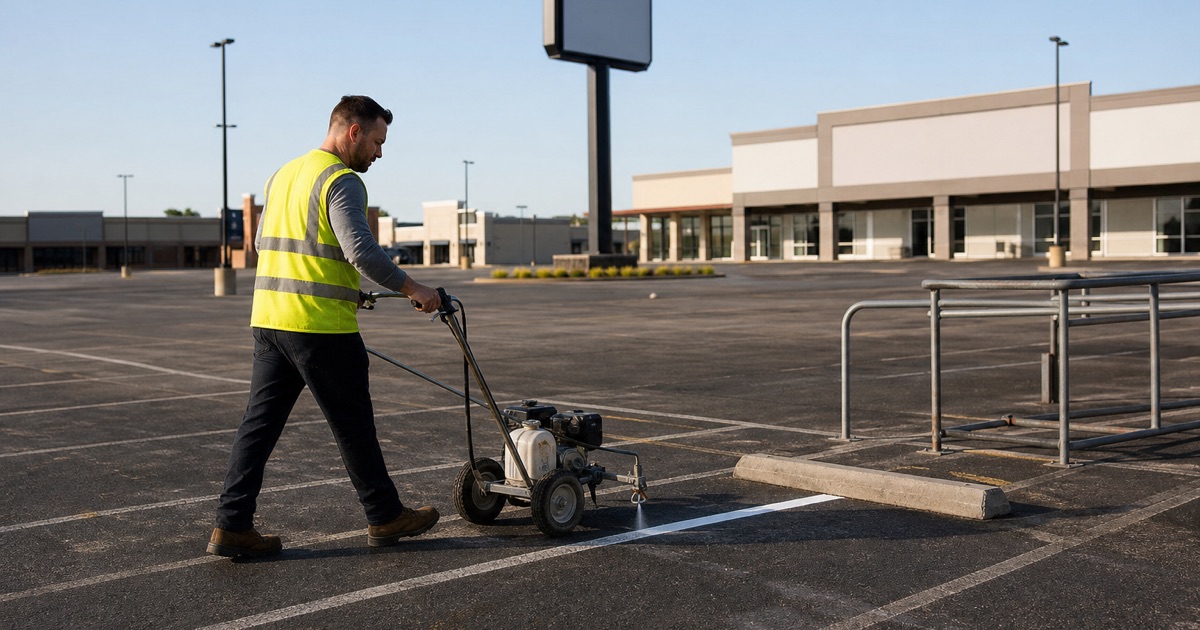
The Anchor Sets the Whole Layout
Every design decision on this kind of site starts from where the anchor’s doors are. The rows facing that entrance carry the demand, the aisle serving them carries the traffic, and everything else on the field is arranged relative to those two facts. Laying a plaza out as though demand were spread evenly is the most common error we are asked to correct.
We draw the layout and get it signed off before any paint reaches the asphalt, so the concentration is planned rather than discovered. That drawing is also where accessible stalls, crossings and cart returns get placed against each other instead of one at a time. Deciding those together is the difference between a coherent field and three separate good intentions.
Satellite Tenants and the Rows Nobody Uses
The smaller tenants around the edge of an anchored plaza have a predictable complaint, which is that their frontage parking is occupied by people shopping somewhere else. Marking cannot solve that on its own, but it can make the far rows genuinely usable rather than nominally available. A row that feels stranded stays empty while drivers circle the front.
Directional marking, a clear crossing back to the storefronts and honest aisle geometry all move drivers further out than they would otherwise go. We treat the underused end of a field as a design failure rather than as surplus capacity. A plaza with a congested front and an empty back is not short of parking, it is short of legibility.
Entry and Exit at Peak
An anchored plaza does not queue gently. Peak trade produces a genuine backup at the entrance, and if the marking does not give arriving drivers a decision point inside the property, that queue ends up on the street. Where the throat allows it, we mark the entry so a car can clear the sidewalk before it has to choose a direction.
The exit deserves the same attention and rarely gets it. Drivers leaving a grocery lot are turning across pedestrians who have just crossed the same line, and a crossing marked to the state’s traffic control manual patterns behaves better than one improvised to fit. Both movements are worth walking before anything gets specified.
Looking for parking lot striping closer to Arcadia? See Arcadia Parking Lot Striping.
Parking That Turns Over All Day
Short Stays Mean Constant Maneuvering
Long-stay parking wears markings mostly where cars drive. Short-stay parking wears them where cars turn, because every stall is entered and left several times a day at the sort of slow, wheel-scrubbing angle that lifts paint rather than passing over it. The damage concentrates at stall entries and aisle ends rather than spreading across the lot.
That changes what a survey should look for. We read the entries and the turning areas first, because those tell us where the field really is in its cycle, and the open pavement between them tells us very little. A lot that looks acceptable from a doorway can be well past due once you stand at the head of a row.
Choosing a Material for Repeated Wheel Traffic
Because a cheap re-mark and a durable one look identical on the day the crew leaves, our quotes name the paint and the application rather than presenting a single figure. On a lot in constant motion the specification is the entire difference between the two, and it shows up months later rather than immediately. Nobody can inspect their way out of a decision made at bid stage.
There is a regulatory floor under that choice as well. Traffic coatings on any lot in this basin are governed by South Coast Air Quality Management District Rule 1113, which limits them to 100 g/L of volatile organic compounds. Compliant product is what we work with, and a bid that only makes sense with something else is worth questioning.
Inspecting to a Cycle Instead of a Complaint
Faded-line inspections here come back with a written interval, so the next round can be budgeted rather than triggered. On a grocery-anchored site that interval is shorter than the same owner’s office property, and telling somebody that plainly is more useful than matching the schedule they hoped for. Being agreeable about a wear rate does not slow it down.
The photographs get organized by area rather than reduced to a single representative image. That lets an owner approve a partial re-mark covering the anchor frontage and the main aisle while leaving the outer rows for the following cycle. Splitting the work that way is usually what makes the honest interval affordable.
Carts, Loading and the Anchor Frontage
Stall Width Where Carts and Doors Meet
Anywhere shoppers arrive back at their car with a loaded cart, stall width stops being a capacity question and becomes a damage question. The cart gets parked alongside the vehicle, the door opens wider than it would in an office lot, and a stall dimensioned for commuters starts generating paint transfer and complaints within a season. Capacity gained by narrowing here gets paid back in disputes.
We raise that at the drawing stage rather than after the first complaint, because it is a trade-off an owner should make deliberately. Sometimes the count genuinely matters more and that is a legitimate choice. What is not legitimate is arriving at a tight field by accident because nobody asked what the parking was actually for.
Where the Corrals Go
Corral placement belongs in the layout rather than being left to whoever pushed the first rack outside. A corral sited badly costs stalls, blocks sight lines at an aisle end, or sits far enough from the rows it serves that carts get abandoned between vehicles instead. All three outcomes cost more than the space the corral occupies.
We mark corral footprints as part of the field so their positions are recorded rather than remembered. A rack that has drifted from where it was intended does steady damage to the stalls around it and nobody notices when it moved. Marking the footprint means the next crew, and the next manager, can put it back.
Pickup and Delivery Bays
Grocery trade has added short-term pickup bays to plazas that were never designed for them, and they are frequently marked as an afterthought in whatever paint was on the truck. A bay that is not obviously temporary or obviously permanent gets treated as neither. Drivers park in it and staff have nothing to point at.
We mark these to the same standard as the rest of the field, with the boundary and the restriction both legible, and we remove them properly when a program changes rather than leaving them to fade. Where a requirement is genuinely short-lived, saying so up front changes what should be laid down. Temporary marking is a specification, not a lower standard.
Working a Lot That Never Empties
Sectioning Instead of Closing
A grocery-anchored plaza cannot surrender its parking during trading hours, and the anchor will not close for a marking contractor. We section the site so part of it stays open throughout, working at night and across weekends, and each area is returned to service before the next comes out. Closing a field outright is not an option anyone here can accept.
That approach costs more nights than a single closure would and it is the only version that works. We write the sequence into the schedule in advance rather than settling it on site, and we agree what happens if a night is lost. A crew standing on a lot it cannot start on costs the same as a crew working.
Removing the Layout Before Adding One
Anchored plazas carry history: a bay for a tenant that left, a delivery zone from an old service arrangement, a crossing that used to lead somewhere. Painting over any of it buys a few months before the old line reappears through the new coat. We take obsolete markings off properly instead.
On a field that wears as fast as this one, that resurfacing happens sooner than owners expect, which makes removal the cheaper decision across the interval rather than the more expensive one on the day. It also means the pavement carries a single readable plan. A driver hesitating over which of two lines is current is a driver stopped in an aisle.
Accessible Stalls, Signage and Devices
Accessible parking on an anchored site has to sit on the route to the doors that everybody actually uses, not merely somewhere on the property. Signage, stalls and access aisles are held against current code on every visit here as standard, and the provision the federal 2010 ADA Standards call for follows the total space count, which on a large plaza is easily got wrong.
Signage, wheel stops and bollards get handled by the same crew on the same visit rather than by separate vendors months apart. Bollards at a grocery entrance take regular contact from carts and vehicles alike, and a struck unit that nobody replaced stops protecting anything. Fixing those while the crew is already on site is a fraction of the cost of a return trip.
- 20+ Years Striping Commercial Lots
- ADA Layouts Checked to Chapter 11B
- Night & Weekend Scheduling











