
Glendale Parking Lot Striping provides parking lot striping in North Hollywood, CA for blocks where an arts and entertainment district and pockets of light industry occupy the same streets. These are not separate districts with a boundary between them. A gallery, a rehearsal space and a fabrication shop routinely sit in the same building or share a driveway.
Mixed tenancy is the whole problem. The businesses on one of these lots want different things from the same pavement at different hours: a workshop needs vehicle access and staging through the working day, while a venue or a studio fills its parking in the evening with people who have never been there before.
The neighborhood contains the NoHo Arts District, the El Portal Theater and the Academy of Television Arts and Sciences, and the North Hollywood Metro Rail station sits at the northern terminus of the B Line. That transit connection changes the parking demand on nearby property in ways owners rarely account for until it is already happening.
Arts District Lots
Visitors Who Arrive in the Evening
An arts or performance tenancy fills its parking in a compressed window before an event and empties it in about the same time afterward, with drivers who are unfamiliar with the property. A layout that regular users navigate from habit will expose every ambiguity in it the moment the drivers are all new.
Directional marking, clear aisle geometry and an obvious route back to the entrance stop being refinements and become the main thing the marking is for. We plan those with the stall layout rather than adding them once the spaces are down, since retrofitted direction ends up where there is room rather than where a driver needs it.
Filling Is Easy, Emptying Is Not
A venue lot that fills in an orderly way and then jams on the way out has failed at the moment everybody remembers. Departure is a different load case from arrival and it is the one that usually goes unconsidered, because a lot is easy to observe filling and nobody stays to watch it empty.
We mark the exit routes and their merge points deliberately for that reason. Drivers who know where they are going merge and drivers who are guessing stop, and one stopped car at a merge point holds up everything behind it. On a small lot that difference is several minutes of queue on a public street.
Loading for Productions and Installations
Arts tenancies take deliveries that a retail lot never sees: scenery, equipment and installation material arriving in large vehicles at irregular hours. The activity settles wherever the driver can fit unless somewhere has been marked for it, which is usually an aisle or an entrance.
We mark loading areas so both the boundary and the restriction are legible, and remove them properly when an arrangement changes rather than leaving them to fade. Where a requirement is genuinely occasional, marking it as temporary and taking it off afterward is more honest than leaving a permanent zone that is used as ordinary parking most of the year.
Looking for parking lot striping closer to Hancock Park? See Parking Lot Striping Services in Hancock Park.
Light Industrial Pockets
Working Pavement Next to Public Parking
A light industrial tenancy uses its pavement for staging, movement and storage, and on a shared block that pavement is directly adjacent to parking used by the public. The boundary between the two is where the risk concentrates and it is frequently the least marked surface on the property.
We mark a defined pedestrian route from the parking to the entrances people use, laid to the California MUTCD crossing patterns where it crosses a vehicle path. Hatching what must stay clear is used sparingly and only where there is a real consequence, since an area hatched for no visible reason teaches everybody to ignore the ones that matter.
One Lot, Two Schedules
The defining conflict on a mixed-tenancy lot is time rather than space. A workshop needs vehicle access and staging during the working day and an arts tenancy needs the same pavement for parking in the evening, and the arrangement between them is usually informal and understood by whoever has been there longest.
Marking turns it into something the property owns rather than something the current tenants remember. Which areas are shared, which are allocated and which must stay clear regardless become a plan a new tenant can read, and the landlord has something to point at when the balance is disputed.
Deliveries Through a Shared Driveway
Mixed blocks share driveways, so a delivery vehicle serving one tenancy arrives through parking belonging to another. The vehicle is large, the driver is unfamiliar, and the route was never marked as a route.
We survey the swept path a large vehicle genuinely needs rather than assuming it, and keep stalls out of it. Losing a couple of spaces to a marked path is a better outcome than a daily conflict both tenants have been absorbing, and it prevents the damage a vehicle does when it takes the room it needs from whatever is beside it.
Transit-Adjacent Parking
Commuter Overspill Onto Private Lots
Property near a rail terminus attracts drivers who park and travel onward, which is a use no commercial lot was intended for and one that quietly consumes stalls all day. Owners usually discover it after the fact, when tenants start complaining that customers cannot park.
Marking and signage are what make a restriction enforceable, and they only work if they agree with each other and remain legible after a few years of wear. Signs go in while the marking crew is on the property so a stall and its restriction come from one specification, because a rule with no readable sign gives an owner nothing to act on.
Short-Stay Parking in a Walkable Area
Transit adjacency also brings people who arrive on foot and park briefly, which puts pedestrians into lots laid out entirely for vehicles. Marking a continuous route from the parking to the frontage changes where people walk more reliably than a sign does.
That matters more on a mixed block than on a retail lot, because the vehicle movements people are crossing include workshop traffic rather than only other customers. A driver reversing a loaded vehicle has less visibility and less room to correct than a shopper does.
Wear Concentrated at the Entrance
Lots used by several tenancies with different hours are in near-constant use, and the wear collects at the entrance and the first turning area rather than spreading across the field. Those are the places a survey should read, because the open pavement between them shows very little.
Every faded-line inspection comes back with a written re-mark interval so the next round can be budgeted rather than triggered by a complaint. A quote from us states the material and how it is being applied rather than resolving to one number, since two jobs indistinguishable on handover day diverge somewhere in the middle of the interval.
Tenancies That Turn Over Faster Than the Paint
Creative and light industrial tenancies both move more often than retail does, and each departure leaves something on the pavement: an allocated bay, a loading zone, a marked area serving a door that is now a wall. The lot accumulates instructions from businesses nobody on site remembers.
We treat a re-mark as an opportunity to clear that history rather than to add another layer to it, which means asking a landlord what is genuinely current before anything is laid. It is a short conversation and it is the one that decides whether the pavement reads as a plan or as an archive.
Compliance, Devices and Condition
Accessible Parking on a Shared Lot
Accessible stalls on a mixed-tenancy property have to serve more than one entrance, which is harder than the count alone suggests, and they have to survive an evening when the lot is full and under pressure. Placing them where a layout had room rather than on a real route is how a property ends up compliant on paper.
Checking the accessible stalls, their aisles and the signage against current code is part of every job rather than a line item somebody has to request. The requirement in the federal 2010 ADA Standards is a proportion of the total provision, and a lot serving several tenancies is exactly where that total gets understated. We recount rather than accept an inherited figure.
Devices That Take Real Contact
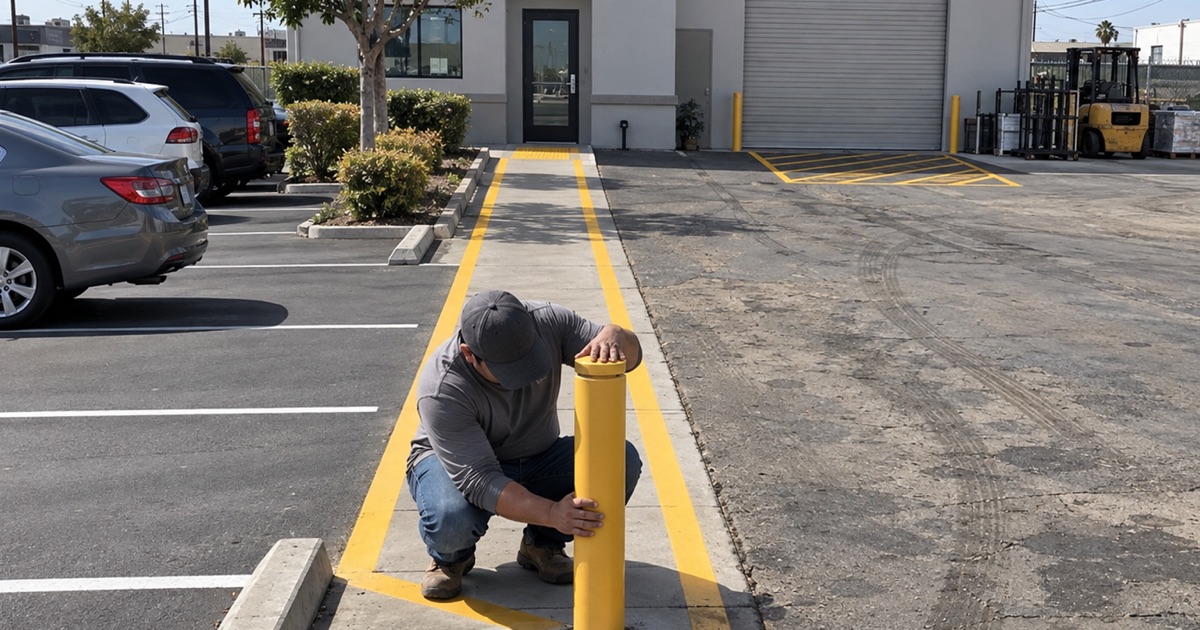
Bollards protecting workshop doors, meters and building corners on a shared lot take contact from delivery vehicles and from evening drivers who do not know the property. They get struck and never replaced, because on a multi-tenant site nobody is specifically responsible for noticing.
Damaged units get swapped out on a visit already booked for marking instead of on a trip of their own, and wheel stops go back against the current drawing rather than against the shadows of a previous layout. A stop protecting something under a plan that no longer applies is doing nothing except taking up room.
Reporting What Is Under the Paint
Pavement on these blocks is generally older than the tenancies using it and has been patched by whoever last needed to open it. We record condition as part of every survey rather than treating it as somebody else’s concern.
The report covers where sealcoating would put money over asphalt that needs repairing first, which sometimes costs us the larger invoice this year. Marking a surface that is breaking up is money spent twice, and on a lot carrying workshop traffic the second bill arrives sooner than an owner expects.
- 20+ Years Striping Commercial Lots
- ADA Layouts Checked to Chapter 11B
- Night & Weekend Scheduling











