
Glendale Parking Lot Striping marks parking structures and decks across Glendale, CA and surrounding cities including Burbank, Pasadena, Hollywood, Koreatown and West Hollywood. Structured parking is common across this part of the basin, and it is genuinely different work from marking an open lot, which is why a contractor set up only for surface work often produces a poor result inside one.
Almost every constraint changes. The substrate is a concrete deck rather than asphalt, and it is frequently sealed with a traffic-bearing membrane that markings have to bond to without damaging it. There is no natural light, so contrast and retroreflectivity behave differently than they do outdoors.
Clearance limits what equipment will physically fit, and columns, ramps and tight turns make the geometry far less forgiving than an open field of stalls. Small errors that would be invisible across an acre of asphalt are obvious in a structure where every stall sits against something.
Ventilation and cure are the practical constraints. An enclosed structure holds odor and vapor far longer than an open lot, which shapes both material selection and how the work is phased around a building that usually cannot close.
What Is Different Inside a Structure
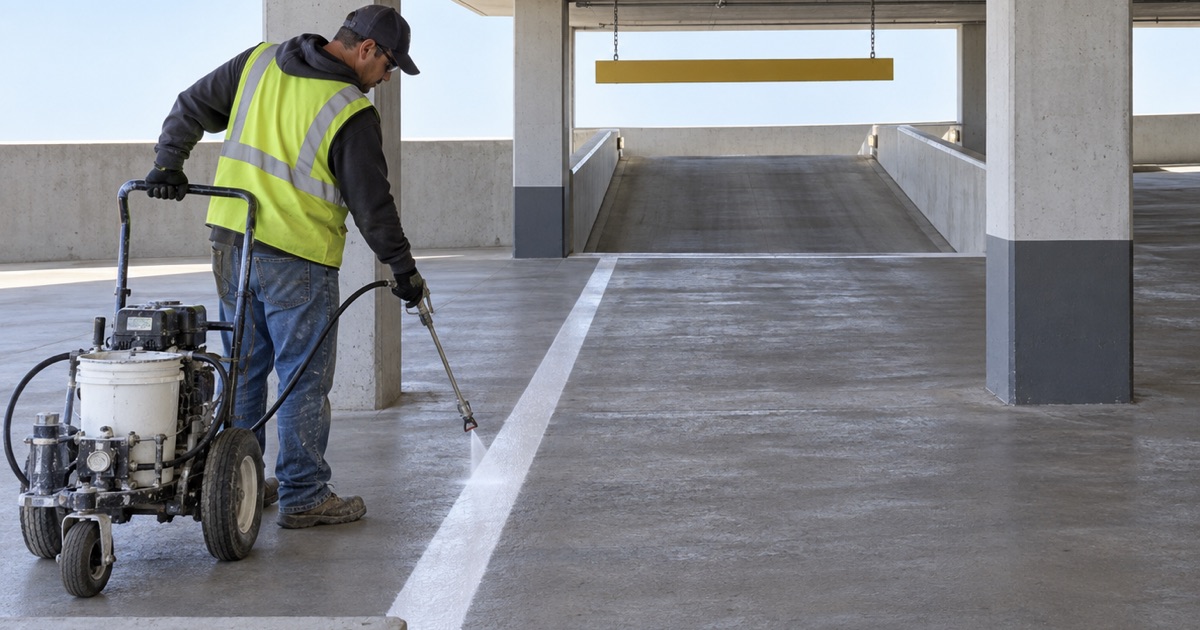
The Deck Is Not Asphalt
Concrete decks, and particularly those with a traffic-bearing waterproof membrane, need materials chosen to bond to the coating rather than to bare concrete, and preparation appropriate to the finish. Aggressive mechanical preparation can damage a membrane that is doing an important job keeping water out of the structure.
We establish what the deck is coated with before specifying anything, because the wrong material or the wrong preparation on a membrane is an expensive mistake to make on someone’s structure. Where the original coating specification is not on file, that is worth establishing before work is scheduled rather than during it.
Light, Contrast and Retroreflectivity
Marking inside a structure is read under artificial light, often poor and often patchy. Contrast against a gray deck matters more than it does against black asphalt, and glass beads behave differently under headlight in an enclosed space than they do outdoors.
Getting this right is largely why structures marked by a surface contractor often feel harder to navigate than they should. Markings that read perfectly well in daylight on an open lot can be genuinely hard to follow two levels underground.
Clearance Constrains the Work
Low headroom limits which machines fit and how they can be maneuvered, and clearance bars at entrances constrain what can be brought in at all. That affects both the equipment and the schedule, because work that would be quick outdoors can require smaller machines and more passes inside. It is worth knowing before comparing a structure quote against a surface lot quote on a price-per-stall basis.
Marking a Structure Correctly
Ramps, Chevrons and Direction
Ramps and their transitions are where structures generate most of their conflicts, and directional marking there does more for safety than anywhere else in the building. Chevrons and directional arrows follow the same specifications as outdoors: white, and set at the prescribed angle rather than judged by eye.
One-way circulation, which most structures depend on, only works if it is legible at every decision point rather than only at the entrance. A driver who has lost the thread halfway up a ramp will make their own decision, and it is usually the wrong one.
Columns, Clearance and Protection
Columns take repeated impact and are worth marking and protecting, and clearance heights need to be signed accurately at entrances and at any point where headroom changes. A structure that under-states its clearance loses vehicles it could take; one that over-states it eventually loses a vehicle roof.
Column corner protection, wheel stops and bollards are installed on the same visit, with anchors suited to a suspended slab rather than the spikes used in asphalt. Fixing depth into a suspended deck is constrained in a way it never is outdoors, and that constraint decides what can be installed at all.
Accessible Provision Inside
Accessible stalls in a structure carry the same California requirements as they do outside, with the additional constraint that van spaces need vertical clearance along their route as well as at the stall. That route requirement is one of the more common defects in older structures that have been re-marked without it being checked. A stall can be perfectly marked and still fail because a duct or a beam sits over the path leading to it.
Working Around a Building That Cannot Close
Level by Level, Overnight
Structures are marked level by level, usually overnight, so the building keeps operating. We work with property management on which levels can be released and when, and we keep each level’s marking complete rather than leaving a half-marked deck in service. A level returned to use with its stalls marked but its direction arrows missing generates more confusion than one still closed.
Odor and Ventilation
Enclosed space holds solvent odor and vapor much longer than an open lot, which matters where a structure sits under offices, apartments or a hotel. Material selection and ventilation planning are part of the scheduling conversation rather than an afterthought, and low-odor options are worth their cost in an occupied building.
Coordinating With Deck Maintenance
Marking is downstream of any deck coating or membrane work, so if a structure has waterproofing scheduled the marking should follow it rather than precede it. We will say so and wait rather than painting a deck that is about to be recoated.
- 20+ Years Striping Commercial Lots
- ADA Layouts Checked to Chapter 11B
- Night & Weekend Scheduling