
Glendale Parking Lot Striping provides scheduled parking lot maintenance for commercial property across Glendale, CA and surrounding cities including Montebello, Huntington Park, South Gate, Commerce and Santa Fe Springs. Maintenance here means a planned cycle with written intervals rather than a phone call after somebody complains.
The economics of this are not subtle. A lot on a cycle gets crack sealing before water reaches the base, coating before the surface oxidizes badly, and markings refreshed before they become an access problem. A lot managed reactively gets patching, then repair, then eventually reconstruction, in that order, at each stage paying more than the intervention that would have prevented it.
What makes a maintenance relationship worth having is documentation rather than frequency. A property manager needs to know what condition the lot is in, what it will need and when, and what each item will cost, in a form that survives a budget meeting and a common area reconciliation.
What a Maintenance Program Covers
Condition Survey and Written Intervals
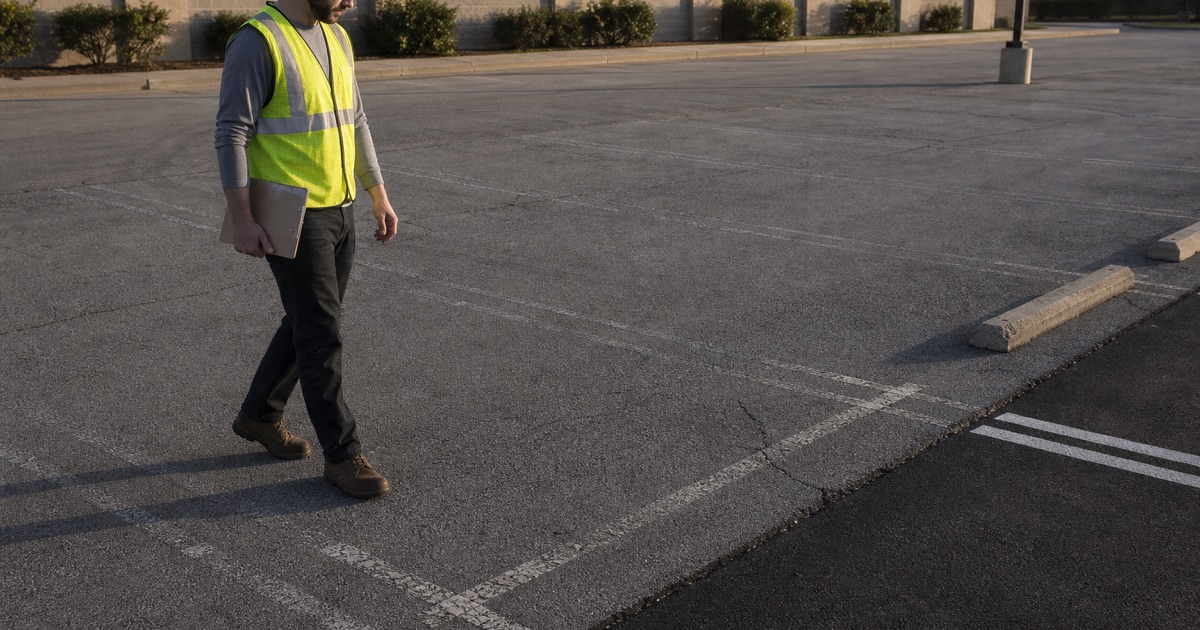
Every program starts with a survey that records crack pattern and width, areas of raveling and oxidation, ponding, failed patches, trip hazards, and the condition of accessible stalls, aisles and signage. That becomes a baseline rather than a one-off report.
From it we set written intervals: when the lot should next be crack sealed, when it should be coated, and when the markings will need refreshing. An interval you can budget against is worth considerably more than a good price on a job you did not plan for, because the unplanned job is the one that arrives in the wrong fiscal year.
Routine Items on a Cycle
The recurring work is crack sealing, sealcoating on its own longer cycle, re-striping, replacing damaged wheel stops and bumps, and refreshing signage that has faded or been damaged. Individually these are small; the value is that they happen at the right time and during a visit that was already scheduled.
Replacing a cracked wheel stop while a crew is on site for striping costs a fraction of sending someone out for it, which is much of the argument for a program. The same is true of a bent sign post, a missing bollard cover or a single faded legend.
Compliance Items Checked Every Visit
Accessible stalls, access aisles, pavement symbols and signage are checked on every visit as a matter of course, not only when we are asked. The California Building Code treats maintaining accessible features as an obligation in its own right, so a symbol weathered to a pale outline is a live code issue rather than a cosmetic one.
Fire lane markings and red curb are checked on the same basis, because a faded restriction is one that cannot be enforced against a vehicle parked in it. Red curb fades faster than anything else on the property, so it tends to be the first item on a lot to fall out of compliance.
Documentation and Budgeting
Reports Built for a Budget Meeting
Findings are itemized by area and by type rather than presented as a single line reading lot maintenance, and finished work is photographed section by section rather than as one shot of the best-looking row. That gives a manager something to present and something to defend. It also means the next survey has a like-for-like comparison rather than a recollection.
Maintenance Against Capital
Routine striping and repair are generally treated as maintenance, while resurfacing and reconstruction are generally capital events, and which side an item falls on affects how it is recorded and whether it can be recovered from tenants. We describe work precisely enough that an accountant can make that call without calling us back.
Vague scope language on an invoice is what turns a routine cost into a disputed one at reconciliation, and it is entirely avoidable. Naming the area, the work and the material takes no longer to write and removes the argument before it starts.
Reserve Studies and Association Property
Community associations working to a reserve study already have pavement on a scheduled cycle with a periodic inspection requirement, and our surveys are written to slot into that rather than sit beside it. For associations the useful output is a defensible remaining-life estimate and a cost, not a sales proposal. Boards are generally being asked to justify a number to their members, and a document written for that purpose is more use than a quote.
Running the Work Without Closing the Property
Phasing Is Planned, Not Improvised
Maintenance work is sectioned so part of the lot stays open and usable throughout, and the phasing plan is written into the schedule rather than negotiated with a tenant on the morning. On multi-tenant retail we work the plan around the trading hours that matter most.
Nights and Weekends
Most of this work happens at night or across weekends, because a retail center cannot surrender its parking during trading and a medical office cannot lose its accessible stalls during clinic hours. The premium for working out of hours is usually smaller than a day of lost trade, and for a multi-tenant property it avoids an argument with whichever tenant would have absorbed the disruption.
Knowing When to Recommend Nothing
The most useful thing a maintenance program does is tell you what not to spend. A lot that has just been coated does not need coating again, a lot heading for reconstruction should not be sealed first, and a marking still within its service life should be left alone. We would rather report that than invoice for it.
- 20+ Years Striping Commercial Lots
- ADA Layouts Checked to Chapter 11B
- Night & Weekend Scheduling