
Glendale Parking Lot Striping supplies and installs parking lot signage across Glendale, CA and surrounding cities including Burbank, Arcadia, Monterey Park, Montebello and West Hollywood. Signage is the half of a compliant parking lot that gets bought separately, installed casually and then fails an assessment while the paint underneath it is perfect.
The pattern we see most often is a property that has invested properly in striping and then sourced its signs from a general supplier, ending up with a sign that looks correct and does not meet the specification. Accessible stall signage in California carries requirements for symbol, color, reflectivity, minimum area and specific fine wording, and a sign that misses any of those is a finding regardless of how tidy the stall is.
Because we install signage on the same visit as the striping, the stall and the sign that governs it are specified together by one crew. That also means a property is not paying two contractors to mobilize for work that belongs on one schedule, and there is no gap where the paint is down and the signs have not arrived.
Signs the Code Requires
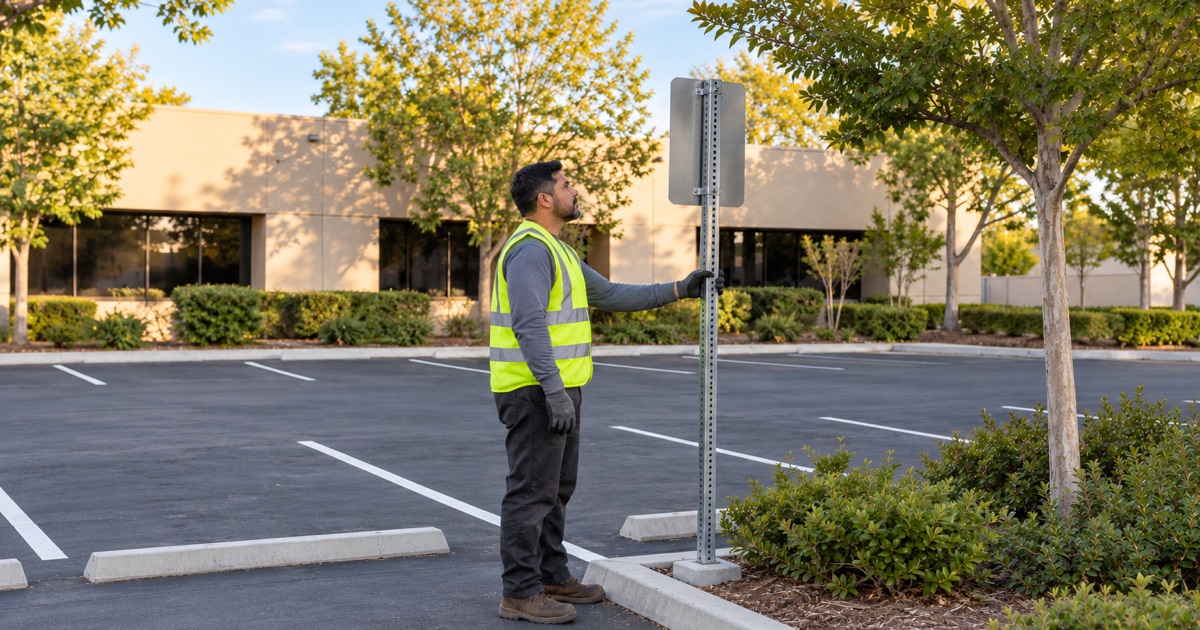
Accessible Stall Signage
Every accessible stall needs a sign carrying the International Symbol of Accessibility in white on blue, reflectorized, meeting a minimum area, and California additionally requires specific minimum fine wording. Signs are mounted at a height that keeps them visible over a parked vehicle rather than hidden behind one, which is a detail that gets missed whenever signage is fitted before anyone has seen the stall in use.
A correctly striped stall with a missing, faded or non-compliant sign is still a finding, and it is the most common single defect we are called out to correct on lots that were otherwise done well.
Tow-Away Notices
California requires tow-away signage at property entrances at its own specified size and lettering, and this is the item most frequently absent altogether. Without it, a property’s ability to have a vehicle removed from an accessible stall is compromised no matter how well the stall itself is marked. It is a cheap sign to fit and an expensive one to be missing.
Fire Lane and Restriction Signs
Fire lane signage is specified by the local fire authority rather than uniformly, so dimensions, wording and spacing differ between neighboring cities. We confirm the requirement for your address before ordering rather than fitting whatever we fitted on the last job in the next city over. Ordering signs to the wrong specification is worse than ordering none, because the property then believes the matter is closed.
Posts, Bollards and How Things Are Fixed
Post Type and Substrate
Signs are mounted on u-channel, square perforated tube or breakaway posts depending on location, exposure and whether an impact is likely. The post has to suit the substrate as much as the sign: an asphalt installation is a different fixing from a concrete slab, and a suspended deck is different again.
Posts set into inadequate material lean within a season, and a leaning sign reads as neglect to anyone assessing the property even when the sign itself is compliant. Breakaway posts have their place near drive aisles, where a rigid post turns a minor impact into a vehicle repair.
Sheeting Grade and Night Visibility
Sign faces are made with retroreflective sheeting graded from engineer grade through high-intensity prismatic to diamond grade, and the grade determines how brightly the sign returns headlight at night. Regulatory signs on a lot used after dark deserve a higher grade than a daytime-only office park.
Sheeting also degrades with ultraviolet exposure, which in this region is the limiting factor on sign life far more than physical damage. A sign that has gone dull is doing less than it appears to be.
Bollards and Physical Protection
Bollards protect storefronts, utility equipment, columns and pedestrians from vehicle impact, and they are specified by pipe diameter, wall thickness and how they are set into the ground. A bollard that is not embedded deeply enough into an adequate footing transfers the impact rather than absorbing it.
We install embedded, surface-mounted and removable types, and we are candid that a decorative sleeve over an inadequate core is protection in appearance only.
Getting Signage Right on the Property
Placement Against the Accessible Route
Signs and their posts must not obstruct the accessible route between a stall and the building entrance, and a post planted in the middle of an access aisle converts a compliant stall into a non-compliant one. Placement is checked against the route rather than against where a post is convenient to set. This is the failure that most often turns up on lots where signage and striping were bought from different contractors, because neither party owned the route as a whole.
Replacing Faded and Damaged Stock
Signs fade, get struck, and get stolen, and replacing them individually during a visit already scheduled for striping costs very little. We note damaged and non-compliant signage whenever we see it on a property, whether or not it forms part of the work we were called for. On a maintenance cycle the replacements tend to be absorbed into a visit that was happening anyway.
One Crew, One Visit
Striping, signage, bollards and wheel stops are handled together, so a lot does not need separate vendors for the paint and the hardware that makes the paint enforceable. It also means responsibility is not split when something is later found to be wrong, which matters more than it sounds when an assessment turns up a defect and two contractors each point at the other.
- 20+ Years Striping Commercial Lots
- ADA Layouts Checked to Chapter 11B
- Night & Weekend Scheduling