
Glendale Parking Lot Striping carries out parking lot striping in Santa Fe Springs, CA across one of the most concentrated industrial districts anywhere in our service area. Scale is the defining feature here: this is large-format logistics property, where a single site can carry more marked pavement than an entire shopping center somewhere else on our list, and that changes how the work has to be planned.
Scale changes the job in ways that are easy to underestimate from a smaller site. A yard measured in acres needs a marking plan rather than a layout, sequenced across several nights, with materials chosen for how long each individual zone has to last rather than one specification rolled uniformly across everything. It also needs a contractor willing to say honestly what a full re-mark costs before you commission half of one and run out of budget partway.
The other consequence of scale is that errors are expensive to undo. Setting a yard out incorrectly and discovering it after the paint is down means removal across a very large area, at a cost that dwarfs the original marking. That is the reason everything here is drawn, checked and agreed before a machine moves rather than resolved on the night.
Marking at Logistics Scale
A Zone Plan, Not a Layout
A large logistics yard is really six sites sharing a fence: dock apron, trailer storage, tractor parking, employee parking, circulation and pedestrian routes. Each carries a different load, wears at a different rate and deserves its own specification rather than a single product applied everywhere because it simplifies the order.
We produce a zone plan showing what is marked where and in which material, and that document turns out to matter more than the marking. It is what a facilities team needs at the next cycle, when the reasoning behind the original decisions has left with whoever made them, and it is the difference between repeating a plan and reinventing one.
Material Chosen Zone by Zone
Spending on a heavier build in the apron and the main circulation routes while using standard traffic paint in low-traffic storage areas produces a materially better result for the same total outlay than treating every square foot identically. It is a deliberate decision worth taking at plan stage rather than a default, and it is the kind of choice that only gets made once somebody has divided the site into zones on paper.
The alternative, which we see often, is a yard marked to one middling standard throughout. The apron fails within a year while the storage areas still look almost new, and the whole site gets dragged back for a re-mark it did not need. Paying twice for the same pavement is the usual outcome of treating a logistics yard as one uniform surface.
Setting Out Across an Acre
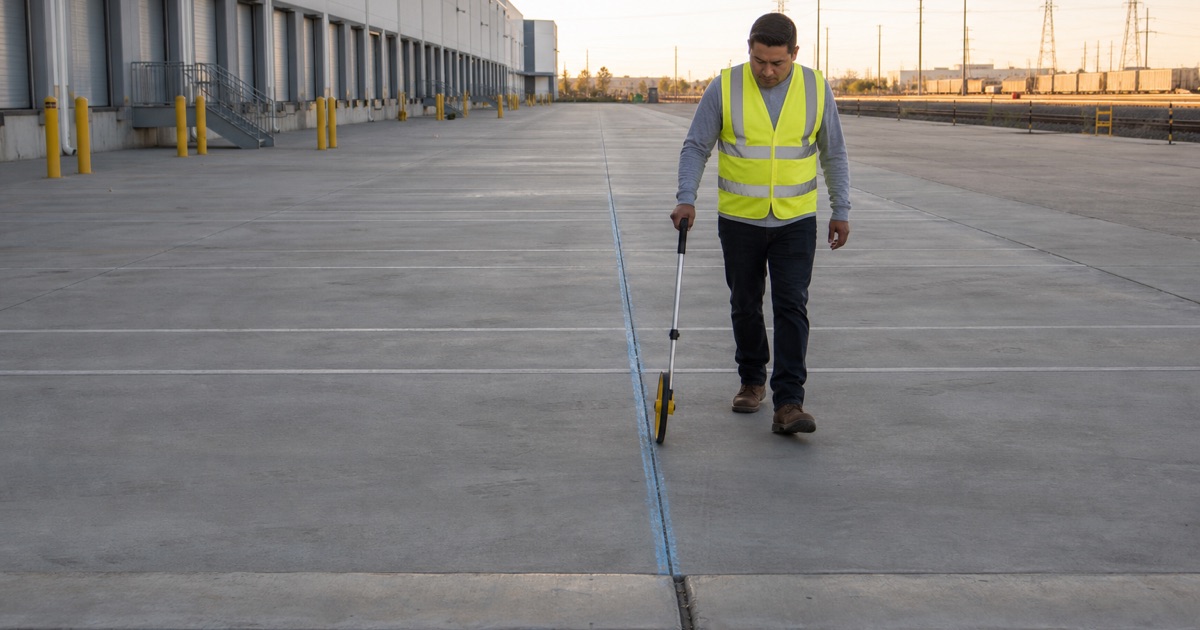
Setting out a yard this size is closer to a survey exercise than to running a string line off a curb, and it cannot be done by eye. Reference points are established across the site and worked from consistently, so the far end of the yard lines up with the near end when the two finally meet.
That sounds obvious and it is precisely where large-site marking most often goes wrong. A cumulative error of a few inches per row is invisible until it reaches a boundary, and by then it is a removal job rather than an adjustment.
Looking for parking lot striping closer to El Segundo? See El Segundo Parking Lot Striping.
Dock Aprons and Trailer Parking
The Apron Is Its Own Specification
Dock aprons absorb concentrated abrasion from loaded trailers turning hard against a building face, and markings there reach the end of their life on a completely different schedule from anything else on the site. Specifying that zone separately is the single most useful decision available on a distribution property, and it is the one most often skipped when a yard is quoted by the square foot.
Where a client is working to a constrained budget, marking the apron properly and the storage areas economically almost always beats doing the whole yard to one compromise standard. It concentrates the money where the wear actually is.
Trailer Positions Laid to the Equipment
Trailer storage is set out to the length and swing of the equipment the site genuinely runs, with drop and retrieve accounted for rather than assumed. A yard marked to over-generous positions quietly holds fewer trailers than the pavement could carry, which is capacity paid for and not used.
Marked too tight, the opposite happens: every retrieval from the middle of a row becomes a shunt, and the time lost shows up at the gate rather than on the pavement. Measuring the equipment on site is the only way to get this right, and it takes an hour that pays for itself over the life of the marking.
Numbering and Wayfinding
Position numbering, dock numbering and directional marking together are what let a driver who has never visited the site find the right door without stopping to ask. On a property of this size that is a measurable reduction in gate time rather than a convenience, and gate time is one of the few yard costs a facilities team can actually put a number against.
Numbers have to be sized for legibility from a cab at an angle and placed clear of where the equipment will sit once positioned. A number a parked trailer covers is a number nobody will ever read again.
Circulation, People and Vehicles
One-Way Wherever the Geometry Allows
Large yards work best on one-way circulation, because two tractor-trailers meeting head-on in an aisle is a slow and awkward problem to unwind. Directional arrows and lane markings are laid to the state traffic control manual’s specifications rather than improvised to suit the shape of the yard.
Where a genuine two-way route is unavoidable, the marking has to make that explicit rather than leaving it ambiguous. Drivers behave predictably when the rule is legible and unpredictably when it is not.
Pedestrian Routes Across a Large Yard
The distance from a gate or an office to a dock can be considerable here, and a walkway that runs only part of the way is worse than no walkway at all, because it ends exactly where people most need guidance. Routes are marked continuously from origin to destination.
Crossings are then placed to minimize the number of times a person has to step into a traffic path, and they are marked to the code patterns rather than by eye. Fewer, clearly marked crossings beat many casual ones, because a driver learns where to expect people rather than having to watch every point along a run.
Employee Parking Kept Clear of Freight
Separating staff parking from freight movement is inexpensive to mark and disproportionately valuable, and on most sites it can be achieved without giving up a single stall. It is among the first things we look at on a yard that has grown without a plan behind it.
The usual finding is not a dangerous layout but an undecided one, where staff and trailers share space because nobody ever drew a line. Drawing it is often the whole intervention, and it costs less than almost anything else on the proposal. Nobody chose the arrangement that exists; it simply accumulated.
Delivering the Work
Surface Condition Before Marking
A yard carrying loaded trailers takes point loading no car park ever sees, and surface failure at dock approaches and turning points is common on older sites here. We record pavement condition zone by zone as part of the survey rather than treating it as somebody else’s problem.
Where an area needs repair before it is worth marking, we say so and sequence it accordingly. Paint laid over a surface that is breaking up disappears with the asphalt underneath it, and on a yard this size that is a great deal of money to lose to a season.
Phased Across Several Nights
A site of this size is marked zone by zone across several nights, with each area returned to service before the next comes out. The schedule is agreed and written down in advance, because a logistics operation cannot absorb an improvised change at short notice and a missed window can push an entire phase back a week.
We build slack into that plan rather than assuming every window will be free when we reach it. A sequence renegotiated in the middle of a night shift costs more than the one that allowed for a delay in the first place.
Documentation That Outlives the Staff
The zone plan, the material schedule and photographs organized by area are handed over as a record rather than kept as our working notes. Facilities teams turn over, and a marking scheme that exists only in one person’s memory becomes guesswork at the next cycle.
We also give a written interval per zone rather than a single figure for the property, because an apron and a storage area genuinely do not come round together. Treating them as one number produces a yard that is half worn out and half freshly marked.
- 20+ Years Striping Commercial Lots
- ADA Layouts Checked to Chapter 11B
- Night & Weekend Scheduling











