
Glendale Parking Lot Striping has been sealcoating commercial parking lots for more than twenty years, working across Glendale, CA and surrounding cities including Burbank, Eagle Rock, Atwater Village, La Crescenta-Montrose and La Cañada Flintridge. Sealcoating is the part of lot maintenance most often sold badly, because a freshly sealed surface looks identical whether or not the asphalt beneath it was ready for the coating.
We work on commercial, industrial, institutional and multi-family property only. Sealing a residential driveway is a different job at a different scale, with different equipment and a coating the air district regulates as its own separate category, and a crew set up for an acre of traffic-worn asphalt is the wrong crew for a two-car driveway.
The most useful thing we do on a sealcoating inquiry is tell you when not to buy one. Sealcoat protects sound asphalt from oxidation and water intrusion; it does not bridge structural cracking and it does not repair a failing base. Applied over either, it buys a season of appearance while the failure underneath continues, and we would rather write the smaller proposal than the one that wastes your money.
What Sealcoating Actually Does
Oxidation Is the Failure It Prevents
Asphalt binder hardens and loses flexibility under ultraviolet exposure, which is why a neglected lot fades from black toward light gray and begins to ravel at the surface. Sealcoat replaces that sacrificial top layer and slows the process. In this region ultraviolet exposure and traffic volume are the drivers rather than freeze-thaw cycling, so the maintenance case here rests on oxidation and water intrusion rather than on frost damage.
What It Will Not Do
A sealer is a coating, not a structural repair. It will not close a crack wide enough to take a coin, it will not stabilize alligatored pavement over a soft base, and it will not level a depression that ponds water. Those need crack sealing, patching or base repair first, and sequencing them correctly is most of the value in a maintenance plan.
Where It Belongs in the Sequence
Repair first, seal second, stripe third. Every one of those steps undoes the one before it if run out of order, and the most common expensive mistake we are called to correct is a lot that was sealed and striped while the asphalt underneath still needed attention. We report surface condition in writing so the sequence is a decision rather than an assumption.
Coatings, Application and What Is Legal Here
The Coating Categories Are Not Interchangeable
Sealers are broadly asphalt emulsion, coal tar emulsion or acrylic, and they differ in durability, appearance, fuel resistance and cost. The right one depends on traffic type, on whether the lot takes heavy vehicles or fuel spillage, and on client preference about appearance. We name the product in the quote rather than describing it generically, because that is the line between a cheap job and a durable one.
Squeegee and Spray Are Different Finishes
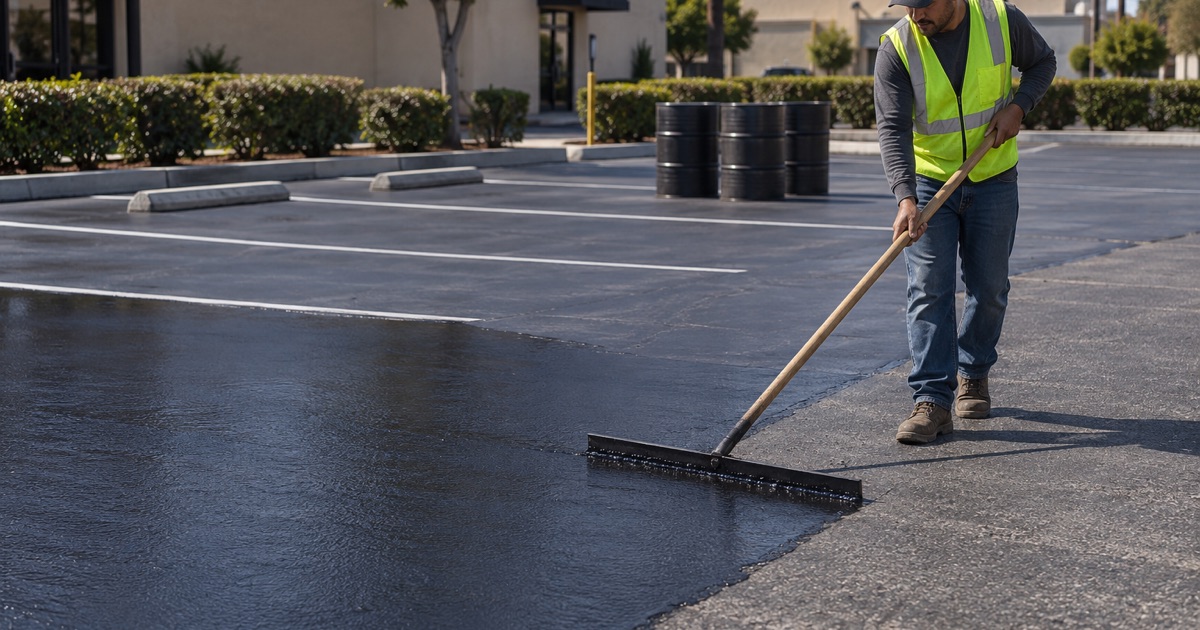
Squeegee application forces material into the surface texture and builds a heavier, more uniform film; spray application is faster and lays a lighter, more even-looking coat. Many lots are best served by a squeegee first coat and a sprayed second. We choose by surface porosity and traffic rather than by whichever is quicker to mobilize.
Air District Rules Apply to the Coating
The South Coast air basin regulates the volatile organic compound content of coatings, and driveway sealers sit in their own category with a tighter limit than the traffic coatings used for markings. That is one more reason commercial lot sealing and residential driveway sealing are not the same purchase. Everything we apply is specified to be legal to apply in this basin.
Preparation, Scheduling and Getting the Lot Back
Preparation Decides How Long It Lasts
A sealer bonds to a clean, sound surface and to nothing else. The lot is swept and blown, vegetation is cut out of cracks and joints, and oil-contaminated areas are treated separately because petroleum rejects coating and will telegraph back through it within weeks. Preparation is the first thing a low bid removes and the thing that decides the result.
Cure Time Is the Real Constraint
Sealer needs to cure before traffic returns, and that window is what dictates scheduling rather than the application itself. We section the lot so part of the property stays open and usable throughout, and we work nights and weekends where a retail or medical site cannot surrender its parking during trading hours. The phasing plan goes in the quote so you can see which areas close and when.
Striping Goes Back On Afterwards
Sealcoating erases every marking on the lot, so a seal job is always also a striping job. Because the same crew handles both, the layout goes back down as soon as the surface is ready rather than waiting for a second contractor to mobilize. It is also the natural moment to correct a layout that was not working, or to bring accessible stalls up to current requirements while the surface is already blank.
How a Sealcoating Job Runs
We Survey and Report Before Quoting
The visit starts with walking the lot and recording what is actually there: crack width and pattern, areas of raveling, ponding, oil contamination, and whether the pavement flexes anywhere underfoot. That record is what the proposal is built from, and you get it in writing whether or not you buy anything.
Where the survey finds that sealing is the wrong purchase, the report says so and explains what to spend on instead. That is not a sales tactic we can afford to fake, because a lot that fails a year after we sealed it is a lot we have to explain.
Repairs and Crack Sealing Come First
Cracks are cleaned out and filled with a hot-applied sealant appropriate to a hot, dry climate, and any patching is completed and given time to settle before coating. Sealer applied over an open crack does not close it; it drapes into it and splits again at the first movement.
Vegetation growing through joints is cut out at the root rather than trimmed at the surface, because anything left will push straight back through a fresh coating within a season.
Cleaning and Oil Treatment
The lot is swept and blown down to a clean surface, and oil-contaminated areas are treated separately with a primer or burned off, depending on how deeply the petroleum has penetrated. Untreated oil rejects the coating and reappears as a dark patch within weeks.
This is the stage a low bid skips, because it is labor rather than material and it is invisible in the finished job. It is also the stage that decides whether the coating is still intact in three years.
Application, Cure and Reinstatement
Coats go down by squeegee, by spray, or as a squeegee first coat followed by a sprayed second, chosen by surface porosity and traffic rather than by speed. The lot is barricaded section by section so the property keeps functioning, and the cure window rather than the application time is what dictates the schedule.
Once the surface is ready, the layout is set back out and painted, accessible stalls and aisles are checked against current requirements, and the finished areas are photographed by section so you have a record of the whole lot rather than one flattering angle.
- 20+ Years Striping Commercial Lots
- ADA Layouts Checked to Chapter 11B
- Night & Weekend Scheduling