
Glendale Parking Lot Striping provides parking lot striping in Signal Hill, CA for commercial pads cut into a hillside and for the service parcels supporting oil operations between them. The commercial property here sits at several different levels on a distinct rise, and that topography is the first thing any layout has to deal with.
A hillside pad is a piece of ground someone made rather than found. It has been cut and filled to produce a level or near-level platform, which means retaining structures on at least one side, an access ramp connecting it to the road, and drainage that has to be deliberate because water arrives from above and cannot simply spread out.
Between and around those pads sit working parcels serving oil operations, which are a different proposition again: pavement used for vehicle movement, equipment access and staging rather than for parking. The two land uses sit close together and almost nothing about their marking is the same. Quoting one on the assumptions that suit the other is the most common way work on this kind of property goes wrong.
Hillside Commercial Pads
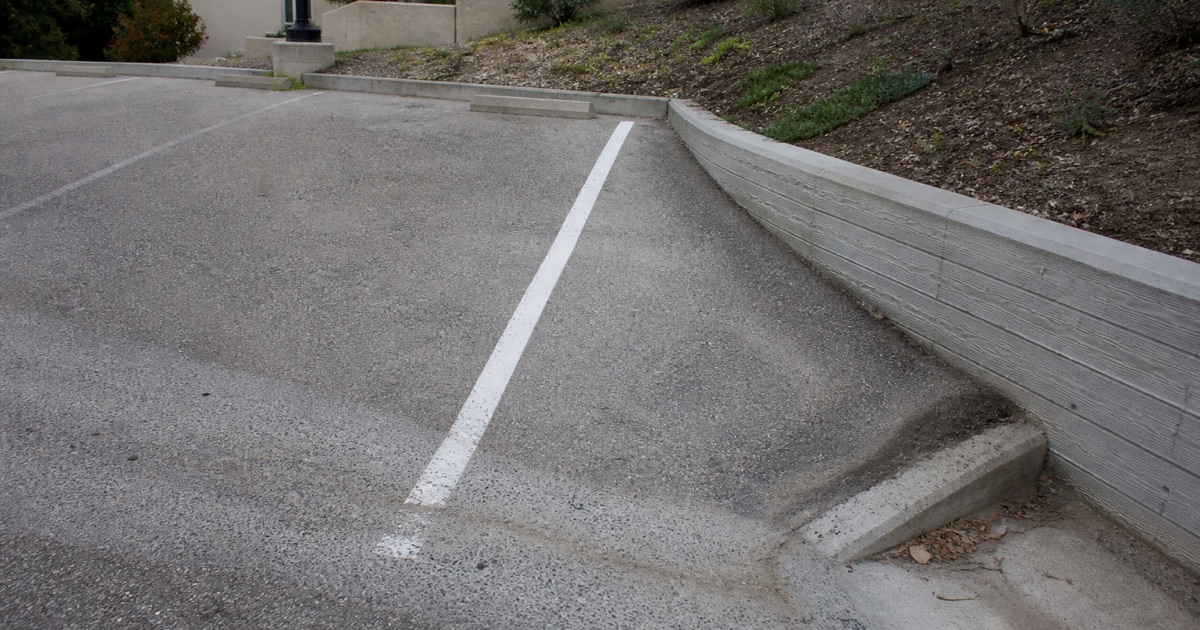
A Platform With Edges
A pad is bounded on the uphill side by a cut and on the downhill side by fill or a retaining structure, and neither edge tolerates a vehicle in the wrong place. The layout has to keep parking off the areas that matter structurally and give drivers something visible to stop against. On a pad the consequences of getting that wrong are more than cosmetic.
We settle that on a drawing before anything is laid, because on a pad the boundaries are fixed and the parking arranges itself around them rather than the other way round. Wheel stops along a downhill edge are doing more than guiding a driver, which is why we set them against the current drawing rather than against the marks left by an earlier layout.
The Ramp Up to the Pad
An access ramp between the road and the pad is where drivers have the least visibility and the least room, and it is frequently the only way in and out. A vehicle stopped part way up holds everything behind it, and a driver reaching the top to find no space has an awkward journey back down. Both of those are decided at the bottom of the ramp rather than anywhere on the pad.
Making the direction unambiguous where it is read before a driver commits is worth more here than an extra stall. Where a pad is served by a single ramp, marking the entry so people can judge the situation from the bottom is a small change that prevents the failure these sites produce most often.
Big-Box Pads and a Larger Field
Some of the pads here carry large-format retail, which puts a substantial field of stalls on a platform with fixed edges. Legibility across the field matters, and the constraint that distinguishes it from a flat site is that the whole thing drains in one direction toward a boundary that cannot simply absorb it.
Marking laid along a flow path wears differently from marking sitting above one, and on a pad that difference is concentrated because the water has one route off. The result is a field that fails in a line rather than in patches. We plan the survey around that rather than reading the field as an average, since the average is comfortable and the flow line is where the specification is actually being tested.
Looking for parking lot striping closer to La Cañada Flintridge? See Parking Lot Striping in La Cañada Flintridge.
Oil Operations Service Parcels
Working Pavement, Not Parking
A service parcel is defined by what has to stay clear: access to equipment, routes for maintenance vehicles, staging ground and the areas around installations that nothing may block. Stall lines are the smallest part of the marking and the exclusions are the largest, which inverts how most of these jobs get quoted and how most of them get inspected.
We plan those with the people running the site rather than around them, because a scheme devised without them is ignored inside a fortnight. Hatching is used deliberately and only where there is a genuine consequence, since an area hatched for no visible reason teaches everybody on the parcel to disregard the ones that matter.
Where People Walk Across a Working Site
Employee parking on these parcels sits next to ground used by equipment and larger vehicles, and the walk from a car to a building crosses it. That crossing is where the risk concentrates and it is very often the least marked surface on the property.
We mark a defined route from the parking to the entrance, laid to the California MUTCD patterns where it crosses a vehicle path. It is inexpensive against the exposure it removes and it is the item most often absent, because the parcel was marked for the operation and nobody ever had the walk on their list.
Surfaces Under Real Load
Pavement on a working parcel takes axle loads and turning forces that retail asphalt never sees, and it fails locally at turns and gate throats rather than fading evenly across an area. Marking follows the surface, so a re-mark over ground that is breaking up is spending twice.
Condition is recorded area by area on every survey and reported as found, including where sealcoating would be money laid over asphalt that has to be repaired first. That occasionally costs us the larger invoice this year and it remains the right report, because paint goes when the asphalt under it goes.
Grade and Drainage on an Elevated Site
Reading the Fall Before Anything Is Laid
Every property here falls somewhere, and where the water travels decides where the marking survives. Silt across an entrance, a scoured edge and a section of paint gone while everything around it holds are all describing the same drainage pattern.
We read that as part of the survey and plan the layout and the material against it rather than treating a graded site as a flat one with a complication. It also tells us where the inspection should concentrate later, because a property judged on its average condition produces an interval that is comfortable and wrong.
Stall Geometry on a Slope
A vehicle parked on a cross-fall sits differently and its doors swing differently, which makes compressing stall width to recover a space a worse trade here than on level ground. The width that reads as generous on a drawing is doing real work for whoever is getting out of the car.
We treat grade as a reason to be generous where a site allows it rather than as an opportunity to fit one more vehicle in, and we say so at the drawing stage when it does not allow it. A stall that is technically present and awkward in practice produces complaints rather than capacity.
Retaining Structures and What Sits Against Them
Retaining walls carry parking against them on a great many of these pads, and vehicles reversing toward a wall in a confined bay make contact regularly. Protection there fails quietly, because a struck bollard or a cracked stop is nobody’s defined responsibility until something more expensive happens.
Damaged units are replaced on visits the property has already booked rather than through separate trips, and their positions are checked against the current drawing at the same time. A stop set for a layout that no longer applies is only occupying ground somebody paid for.
Compliance, Signage and Records
Accessible Parking on a Graded Pad
Grade constrains accessible parking more than any other requirement on these sites, because both the stall and the route to the entrance have to work for somebody moving between a vehicle and a door on ground that falls. The most convenient corner is regularly not an available answer.
Stalls, aisles and the signage above them are checked against current code on every visit as standard rather than on request. The federal 2010 ADA Standards make the provision owed a proportion of the total, and a property with parking on more than one level of a hillside is exactly where that total gets understated.
Signage on Property That Has Changed Use
Signal Hill was incorporated in 1924, roughly three years after oil was discovered there, and property that has carried both industrial and commercial use over that long a period accumulates signage from every phase of it. Reviewing what is standing beats adding to it.
Signs go up while the marking crew is on the property, so a stall and the restriction attached to it come from one specification rather than from two contractors on two dates. Where a sign is faded, obsolete or contradicts another along the same route, we say so rather than leaving it standing.
A Record for the Next Cycle
A faded-line inspection here produces a dated interval for the next round rather than a verdict on today’s condition, with photographs covering the property area by area. On a site with distinct pads and parcels that breakdown is what lets an owner deal with the areas that need it and program the rest.
It also makes the next quote comparable, because the specification exists as a document instead of being reconstructed from whatever the pavement looks like at the time. On property where operations staff change, that record generally outlasts everybody who was involved in commissioning the work.
- 20+ Years Striping Commercial Lots
- ADA Layouts Checked to Chapter 11B
- Night & Weekend Scheduling











