
Glendale Parking Lot Striping provides parking lot striping in South El Monte, CA for the manufacturing and fabrication businesses that occupy most of the city’s industrial parcels. Industry here sits on many small sites rather than a handful of large ones, and that inverts the usual industrial problem: the constraint is not scale but space, and every decision follows from it.
On a compact industrial parcel the yard has to serve deliveries, material storage, forklift movement, staff parking and frequently an outdoor part of the production process itself, all within a footprint that would be a single dock apron on a distribution site. Marking it well means deciding what the site genuinely needs rather than laying out a scaled-down version of everything a larger operation would have.
That makes layout the valuable part of the work here and the painting the straightforward part. An extra two stalls, a clear forklift path, or a staging area that stops blocking a roll-up door is worth considerably more to a small manufacturer than any upgrade in material, and it costs nothing extra to get right at drawing stage.
Working a Compact Industrial Parcel
Every Square Foot Is Contested
On a tight parcel, staff parking, delivery access, material staging and production overflow all compete for the same pavement, and marking the yard is where those competing claims finally get resolved. Doing it properly means asking what actually happens on the site during a working day rather than applying a standard drawing.
We walk the yard and ask about the pattern of work before drawing anything, because the right layout for a shop taking one delivery a day is not the right layout for one receiving material continuously. The two look similar on paper and behave nothing alike, and the difference decides where staging goes and how much of the yard has to stay clear through the day.
Turning Room Sets the Limit
Whatever else a small yard needs, a delivery vehicle has to enter, turn and leave without a multi-point manoeuvre across a live working area. That single requirement frequently dictates the entire layout, and designing around it openly beats marking stalls that then have to be kept empty whenever a truck is due.
Where the geometry genuinely will not allow a comfortable turn, it is better to say so and mark the yard for the manoeuvre the site can actually perform. A layout that assumes room the parcel does not have gets abandoned within a week, and once the markings are being ignored they stop working for everything else too.
Roll-Up Doors and Keeping Them Clear
Marked keep-clear zones in front of roll-up doors and loading points arrest the slow creep of stored material into working space. It is one of the least expensive markings available and it has an effect out of all proportion to its cost.
What it really does is convert a recurring argument into something visible on the ground. Nobody has to adjudicate where material may sit once the boundary is painted, which is why these zones tend to survive changes of staff long after the person who requested them has moved on.
Looking for parking lot striping closer to Culver City? See Parking Lot Striping Services in Culver City.
Yard Circulation and Staging
Forklift Paths and Foot Traffic
Forklifts working between a yard and a shop floor cross pedestrian routes constantly on a compact site, far more often than they would on a large one, and marking those paths and their crossings is the most valuable safety work available here. Crossings are laid to the code patterns rather than improvised.
Where a route runs from an outdoor yard through a doorway into a building, the marking should carry through the threshold rather than stopping at it. A path that ends at the door leaves people to guess exactly where the equipment is densest, which is the opposite of what the marking was bought to achieve.
Staging and Storage Footprints
Marking out where material may be stacked, and equally where it may not, keeps aisles and access routes usable as a site gets busy through the day. These boundaries are the thing almost every small manufacturer knows is a problem and almost none has ever documented.
The useful version of this is drawn with the people who work the yard rather than for them. A staging area marked where the forklift driver already puts things gets respected; one marked where it looked tidy on a plan does not. The people who work the yard already know the answer, and asking them costs nothing.
Interior Floor Marking on the Same Visit
Many of these sites want the shop floor marked at the same time as the yard, and the two follow different color conventions: outside follows traffic marking practice, inside follows workplace safety color coding. Confusing the two is a common and avoidable error.
We handle both and document which scheme applies where, so the distinction survives after we leave. That single sheet is usually the only written record a small operation has of why its floor looks the way it does, and it is what stops the next contractor guessing at a scheme somebody thought about carefully.
Staff Parking on a Small Site
Stall Width Against Stall Count
A manufacturing site with all-day staff parking tolerates a tighter stall than a retail lot would, and on a small parcel that difference can decide whether the workforce fits on site or overflows onto the street. It is a deliberate decision worth taking rather than a number to inherit from whoever painted it last.
We put the trade-off in front of the client with both counts rather than choosing quietly. An owner who knows they are buying two extra stalls at the price of a tighter door swing can make that call perfectly well themselves, and they are better placed than we are to judge how much street parking their staff will tolerate.
Accessible Provision Is Not Optional at Any Size
A small site still owes accessible parking, and on a compact parcel the accessible stall, its access aisle and the route to the entrance have to be planned first rather than fitted around everything else once the layout is settled. We check accessible stalls, aisles and signage on every visit as a matter of course.
Where a site genuinely cannot accommodate what it owes within its current layout, we say so plainly rather than marking something that will not stand up to scrutiny. That is an uncomfortable conversation and a much cheaper one than the alternative, which arrives as a complaint or a claim rather than as a quote.
Getting It Done Without Stopping Production
Signage and Site Hardware
Small industrial sites tend to accumulate signage piecemeal, so a yard often carries a mixture of faded, non-compliant and irrelevant signs that nobody has audited. We supply and set signage on the same visit as the marking rather than leaving it to be sourced separately.
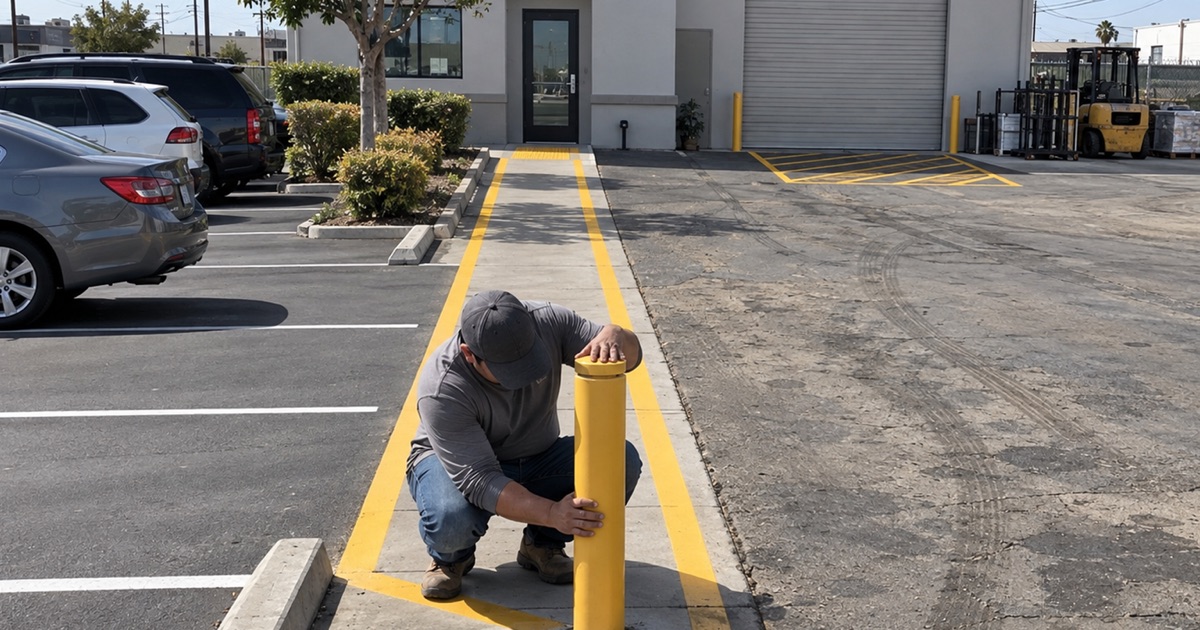
Bollards protecting roll-up doors, gas meters, electrical equipment and building corners matter more on a compact yard than a large one, because there is less room to miss. We install them with anchors matched to the substrate rather than to whatever is quickest.
Short Windows, Sectioned Work
Small sites rarely have spare space to work around, so we work in short sequenced windows, usually overnight or across a weekend, taking one area at a time. Each section is back in service before the next one comes out of use.
That approach costs a little more in mobilization than closing a yard for a day, and for a shop running to order it is almost always the cheaper option overall. Lost production is more expensive than an extra night of striping, and for a shop working to a delivery date it is not a close comparison.
Working With a Landlord or a Tenant
Many of these parcels are leased, and the question of who pays for yard marking is answered by the lease rather than by us. We are used to quoting in a form that a tenant can put to a landlord, or that a landlord can recover through a common area charge.
What that requires is scope described precisely enough to be recorded properly rather than a single line reading yard striping. It takes no longer to write and it removes the argument before it starts.
Honest Reporting on Surface Condition
Industrial yards take heavier point loading than any car park, and surface failure under a loaded forklift or a delivery truck is common on older parcels. We report what the pavement actually needs rather than what we were asked to quote for.
Where marking should wait until a repair is done, we say so, even when it means coming back in a later quarter for work we could have invoiced today. Painting over a failing surface produces lines that break up with the asphalt beneath them, and the money spent on them disappears with it inside a season.
- 20+ Years Striping Commercial Lots
- ADA Layouts Checked to Chapter 11B
- Night & Weekend Scheduling











