
Glendale Parking Lot Striping provides parking lot striping in South Pasadena, CA for a commercial parking supply that is unusually public. A large share of the spaces here belong to the city, to the school district or to another institution rather than to a private landlord, and that changes who we deal with and how the work is bought.
The practical difference is procedural rather than technical. A publicly owned lot is specified, tendered and approved through a process with several people in it, on a timetable set by a budget year rather than by whoever noticed the lines were fading. Work that is not written down clearly enough to be compared against another bid does not get bought at all.
That suits us, because writing things down is already how we work. A quote from us states the material and how it is going down instead of resolving to one number, a faded-line inspection produces a dated interval for the next round, and the survey photographs cover the property area by area rather than picking out its best row. On public property those are requirements rather than courtesies.
Municipal and Civic Lots
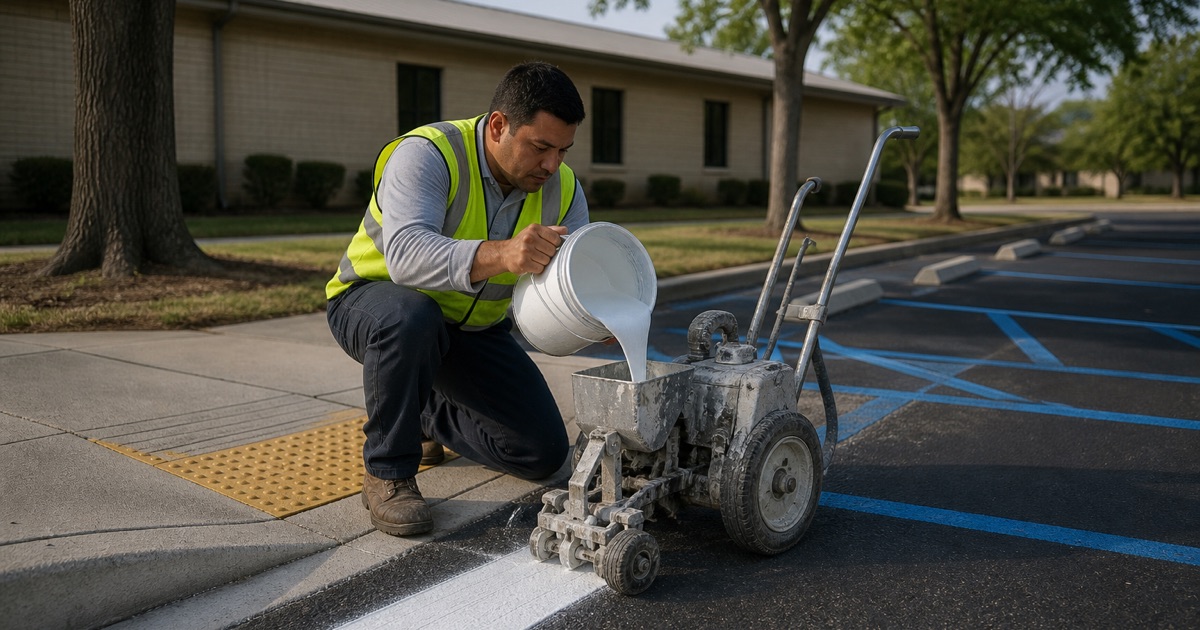
Parking That Belongs to Everybody
A civic lot serves people visiting a public building, staff who work in it, and often the commercial street next to it, and none of those groups has a landlord to complain to. The complaints land with the city instead, which makes clarity in the layout worth more than the last few spaces a tighter arrangement might yield.
We settle the layout on a drawing and get it approved before any paint reaches the asphalt, so the count and the trade-offs behind it are on record. On public property that record is doing more than settling an argument. It is what the next person in the role inherits when they pick the work up years later.
Time Limits and Restrictions That Have to Be Enforceable
Municipal parking usually carries restrictions, and a restriction is only worth having if somebody can act on it. That depends on the marking and the signage agreeing with each other, which is exactly what fails when a lot is re-marked by one contractor and re-signed by another two years apart.
Signs are supplied and fitted while the marking crew is there, which keeps a stall and the restriction printed above it on one specification. Where existing signs contradict each other, and on property that has been maintained in pieces they usually do somewhere, auditing what is standing is more useful than adding another sign to the argument.
Buying Work on a Budget Cycle
Public maintenance runs on a scheduled cycle rather than on a reaction to a complaint, and the constraint on that cycle is that somebody has to defend the number in advance. A written interval is what makes that possible: a date, a scope and a reason, rather than a request that gets deferred because it cannot be justified.
We would rather give an authority a plan it can stage across two budget years than a single number it cannot fund. That usually means identifying which areas genuinely need attention now and which will hold, which is only possible if the survey was recorded by area in the first place.
Looking for parking lot striping closer to Echo Park? See Parking Lot Striping Services in Echo Park.
School District Property
Sites That Change Use Through the Day
A school site is several parking problems in sequence. Staff arrive and stay, buses and family vehicles arrive and leave in two short bursts, and the same pavement is used for something else entirely in the evening and at weekends. Marking it for one of those uses tends to make the others worse.
We plan for the load case that fails first, which on almost every school site is the arrival and departure period rather than the number of spaces. A layout that holds enough cars and still jams twice a day is telling you the problem is circulation, and that is fixable with marking rather than with land.
Separating Buses, Vehicles and People on Foot
The safety argument on a school site is not subtle: children on foot are crossing the paths of buses and family vehicles at the busiest moments of the day, and the marking is much of what keeps those separated. Crossings laid to the California MUTCD patterns behave better than crossings improvised into whatever width was available.
Bus loading needs its own defined area rather than a shared one, because a bus maneuvering among cars is the movement with the least visibility and the least room to correct. We mark the areas that must stay clear so they read as excluded rather than as unused, and specify them to stay legible under heavy use.
Working Around a Calendar, Not a Trading Day
School property has something most of our clients do not, which is genuine closed periods, and those are worth planning around rather than working nights against an occupied site. A holiday period is the cheapest window a district will ever get for this work.
The constraint is that those windows are fixed and short, so the scope has to be right before it starts. We agree the sequence and the fallback in advance, because a session lost in a closed period cannot simply be picked up the following week. On a district property the calendar is the schedule.
Main Street Retail Parking
Small Lots Serving a Compact District
South Pasadena is a compact city in the San Gabriel Valley, and its retail parking reflects that: small lots, close together, each serving more of the street than the business it belongs to. Customers park once and walk, which means the walking route matters as much as the stall it starts from.
We mark that route as a continuous path rather than as unrelated fragments, and we are honest about what a small lot can hold. A count agreed on a drawing is a decision. The same count discovered once the lines are down is a removal job with an awkward conversation attached to it.
Shared Frontages and Adjoining Owners
Small lots side by side, marked by different contractors on different dates to different standards, drift apart with every cycle until a district that is individually maintained collectively looks neglected. No single owner is at fault and all of them have the problem.
Where owners will agree it, neighboring areas can be held to a single written specification with each of them quoted and billed on its own. Nobody surrenders control of their property or their timing. What changes is that the geometry, the material and the interval match across a line no customer can see.
Keeping a Street Trading Through the Work
A main street cannot give up its parking, and in a compact district there is no overflow within walking distance to absorb the loss. Every lot is worked in sections so a usable part of it stays available, at night and over weekends, and no area opens up until the last one has gone back into service.
On small lots the job breaks into more stages of shorter length, and their order counts for more than the pace of them. That order is fixed before the first night, along with what a lost session does to everything after it.
Compliance, Devices and Condition
Accessible Parking on Public Property
Accessible parking on publicly owned property is held to the standard everybody else is held to, and it is more visible because the owner is a public body. It has to sit on a genuine route to the entrance it serves rather than wherever a layout had room.
Accessible stalls, aisles and signage are verified against current code every time we attend rather than when somebody thinks to ask, and the federal 2010 ADA Standards derive the provision owed from the total number of spaces. California Civil Code Section 55.56(e)(1)(F) allows a 15-day window to correct faded parking and access aisle markings once an owner is on notice, and knowing the condition ahead of that letter is worth considerably more than learning it afterward.
Wheel Stops, Bollards and Signage as One Job
Public and institutional property accumulates devices from many separate small works: a bollard added after an incident, wheel stops from a layout that has since changed, signs installed by whoever needed them. Nobody owns the whole picture and so nothing gets audited.
We handle striping, signage, wheel stops and bollards with the same crew on the same visit, so a property does not need three vendors and three mobilizations to be brought back into order. Damaged units are replaced during a visit already scheduled rather than through a separate call-out, which is a fraction of the cost.
Reporting the Surface Honestly
Public asphalt is often older than any of the current staff and has been patched by whoever needed to open it. Marking it is straightforward, and marking it is occasionally the wrong recommendation.
Condition is recorded on every survey and reported as it stands, including where sealcoating would put money over pavement that needs repairing first. That sometimes costs us the larger invoice this year. It is better than paint that disappears with the asphalt under it well inside the interval somebody has already budgeted for.
- 20+ Years Striping Commercial Lots
- ADA Layouts Checked to Chapter 11B
- Night & Weekend Scheduling











