
Glendale Parking Lot Striping installs speed bumps, speed humps and wheel stops on commercial property throughout Glendale, CA and surrounding cities including Burbank, Studio City, Koreatown, Hollywood and West Hollywood. These are the parts of a lot that get specified casually and then cause problems for years, because they are physical objects bolted to a surface that vehicles hit at speed.
Two decisions do most of the work: which device the situation actually calls for, and how it is anchored. A speed bump and a speed hump are not the same thing and do not produce the same result, and a wheel stop fixed with the wrong hardware into the wrong substrate becomes a loose slab in a traffic lane. We install with the anchor system matched to the surface rather than to whatever is on the truck.
Because the same crew handles striping, signage and these devices on one visit, the markings that make them visible go down at the same time. A speed bump that has not been marked is a trip and vehicle hazard rather than a traffic control measure, and it is one of the more common defects we find on lots that used several contractors.
Choosing the Right Device
Bumps, Humps and Cushions Are Not Interchangeable
A speed bump is short and abrupt and enforces a very low crawl, which suits a tight service area or a pedestrian-heavy frontage. A speed hump is longer and gentler and slows traffic without stopping it, which suits a through drive aisle. Speed cushions are split laterally so that wider-axle vehicles can straddle them. Choosing the aggressive option everywhere produces complaints, damage claims and drivers routing around it across the landscaping.
Fire Apparatus Access Changes the Answer
Where a drive aisle forms part of a fire apparatus access route, what may be installed on it is constrained, and the local fire department applies its own amendments on top of the state requirement. A device that would be fine on an internal aisle can be unacceptable on a designated access road. We confirm the route and the requirement with the authority having jurisdiction before installing anything in it.
Wheel Stops Are a Precision Item
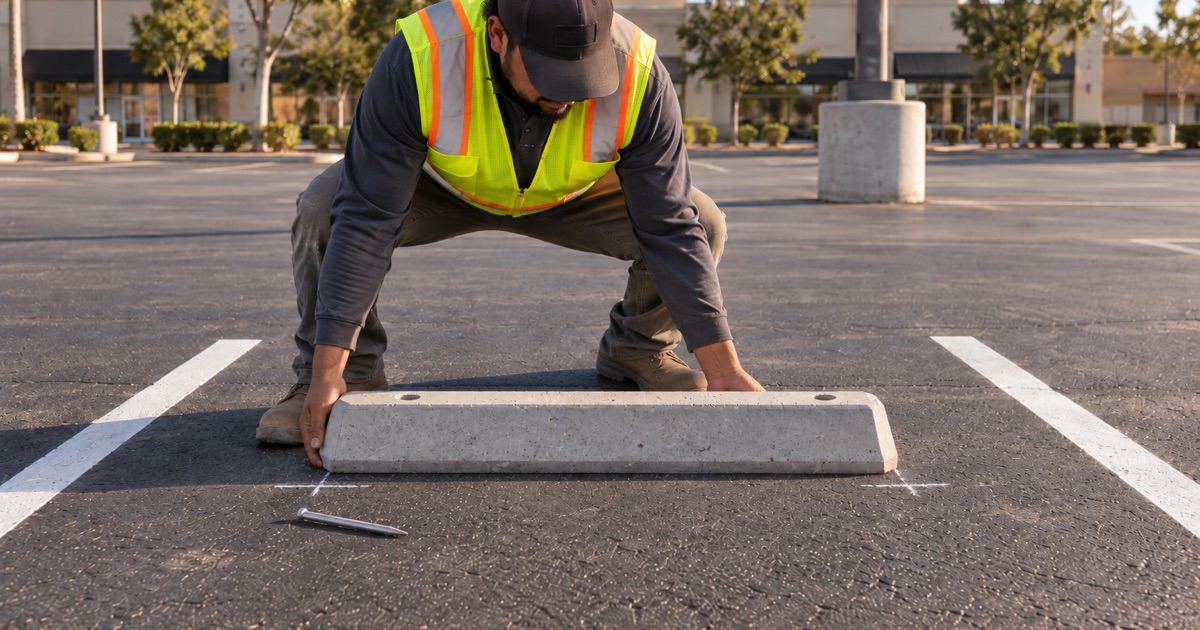
A wheel stop set too far forward lets vehicles overhang a walkway; set too far back it fails to protect the building, the columns or the landscaping it was installed for. Placement is measured against the stall depth and the overhang of the vehicles that actually use the property. Getting it wrong turns a safety device into a trip hazard on a pedestrian route.
Materials and Anchoring
Concrete Against Recycled Rubber
Precast concrete wheel stops are rigid, heavy and long-lived, and they crack when struck hard or lifted carelessly. Recycled rubber and composite units are lighter, more forgiving of impact and easier to reposition, and they generally cost more up front. The right choice depends on impact exposure, on whether the layout is likely to change, and on how the property handles snow-free but heavy commercial traffic.
Anchoring Is Substrate-Specific
Asphalt and concrete take different fixings, and this is where most failures originate. Asphalt installations generally use long spikes driven into the surface; concrete requires drilled anchors set into the slab. Reusing an asphalt spike in a concrete deck, or fixing into a surface that is already failing, produces a device that works loose within months. We match the anchor to the substrate and to the impact the device will take.
Speed Devices Need the Same Discipline
Rubber and composite speed bumps are supplied in modular sections with end caps, and they rely on every fixing being seated properly into sound material. A section that lifts at one end becomes a hazard rather than a control. Asphalt-installed units use spikes; concrete-installed units use drilled anchors, and the end caps matter because that is where a wheel first makes contact.
Marking, Visibility and Keeping Them Serviceable
An Unmarked Device Is a Hazard
Speed bumps and humps are marked so drivers see them before they reach them, and wheel stops on pedestrian routes are marked so people walking do not trip over them. Marking is applied at installation and refreshed on the same cycle as the rest of the lot. This is the most frequently neglected part of the job on properties that split work between vendors.
Accessible Routes Take Priority
Wheel stops must not intrude into an access aisle or block the accessible route between a stall and the building entrance, and a device installed without regard to that turns a compliant stall into a non-compliant one. We check accessible stalls, aisles and the route on every visit as a matter of course. It is the kind of defect that is trivial to prevent and expensive to discover later.
Replacement Is Routine, Not Exceptional
Concrete stops crack, rubber units tear at fixing points, and both take impact damage over time. Replacing individual units as they fail costs very little when it happens during a visit that was already scheduled, which is one of the arguments for putting a property on a maintenance cycle rather than reacting to complaints. We report damaged units when we see them, whether or not they are part of the work we were called for.
Where These Devices Earn Their Keep
Industrial Yards and Truck Courts
A distribution property has different problems from a retail lot: long vehicles with wide turning circles, dock aprons where trailers reverse against a building, and separation between truck movements and staff walking to the office. Wheel stops and bollards there are protecting structure and people rather than landscaping.
Device selection changes accordingly. Speed cushions that let a wide-axle truck straddle them keep yard traffic moving where a full-width hump would slow every delivery and get driven around.
Retail Centers and Medical Offices
High-turnover parking with pedestrians crossing constantly is where speed control does the most good and where complaints about it are loudest. The answer is usually gentler devices placed at the points where drivers actually accelerate, rather than aggressive ones spread evenly across the site.
These are also the properties where wheel stop placement matters most, because drivers pulling in hard toward a storefront walkway are the ones who overhang it. A stop set a few inches out of position either leaves the walkway exposed or becomes the trip hazard it was meant to prevent.
Schools, Campuses and Places of Worship
Sites with heavy pedestrian movement in short concentrated bursts need traffic calming that works when the site is full and is unobtrusive when it is empty. Marked crossings, stop bars and speed humps on approach routes tend to serve better than bumps at the entrance.
Because these properties often run on volunteer or district budgets, we are usually asked what the minimum effective intervention is. It is a fair question and we answer it honestly.
Structured Parking and Decks
A parking structure changes the calculation entirely. Anchoring goes into a suspended concrete slab rather than asphalt, which constrains fixing depth and rules out driven spikes, and low clearance limits what can be installed at all.
Ramp transitions, column protection and directional control matter more than speed humps in that environment, and the marking that supports them has to work under artificial light rather than sunlight.
- 20+ Years Striping Commercial Lots
- ADA Layouts Checked to Chapter 11B
- Night & Weekend Scheduling