
Glendale Parking Lot Striping handles parking lot striping in Studio City, CA for boulevard retail whose parking sits behind the buildings in consistently tight lots. The commercial frontage here is close to continuous, and what is left over at the back is doing all the work for it.
The distinguishing feature is not the size of these lots but the hours they are busiest. A significant share of the frontage is restaurants and evening trade, so demand peaks after dark, arrives in a compressed window and often involves a valet operation stacking cars into a lot that was laid out for self-parking. Every one of those facts changes what should be marked and when the work can happen.
Studio City takes its name from the studio lot established here by Mack Sennett in 1927, now the Radford Studio Center, and the industry’s presence still shapes the trade along the boulevard. What that means for us in practice is a customer base that keeps irregular hours and a set of properties that cannot easily be worked on during any of them.
Tight Rear Lots on the Boulevard
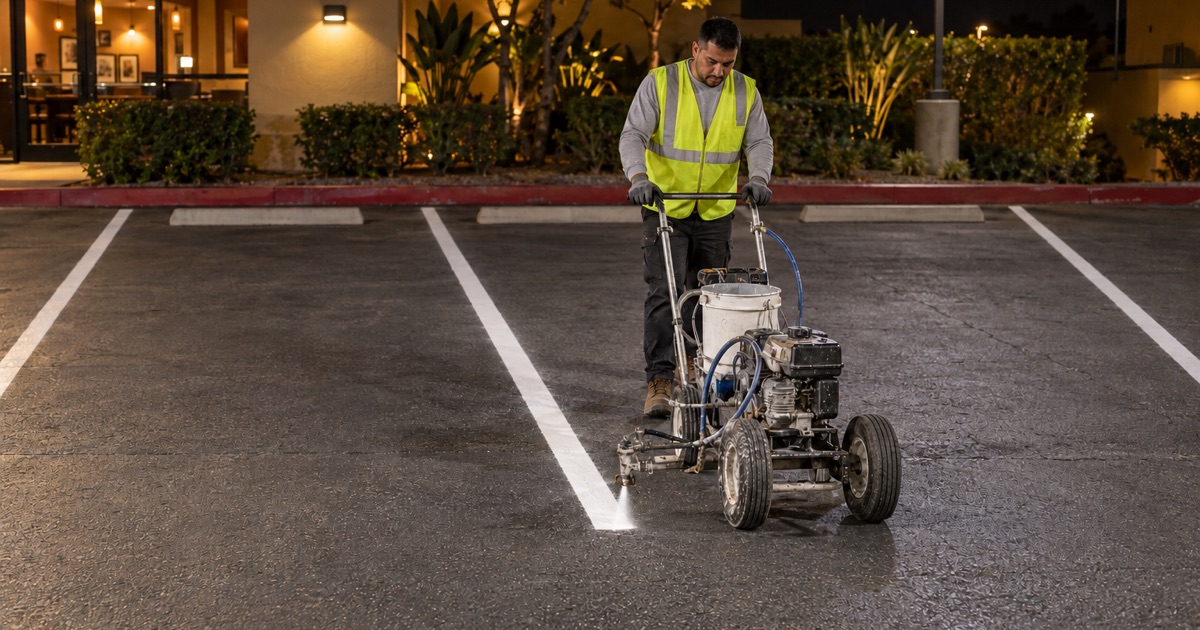
Frontage at the Front, Everything Else Behind
Boulevard buildings meet the sidewalk, so the parking is a rear parcel reached from a side street or a service approach and bounded by walls on more than one side. There is no scope to expand and rarely any scope to reconfigure the access. The layout has to make the shape work rather than improve on it.
We settle it on a drawing before any paint reaches the asphalt, because on a lot this tight a misjudged aisle costs a whole run of stalls rather than one space. A count argued on paper is a decision an owner made. A count discovered afterward is a removal job somebody has to pay for.
The Aisle Is the Constraint, Not the Stall
On a constrained rear lot the aisle width usually decides everything else, since a car needs room to swing into a perpendicular stall and that room comes directly out of the parking. Changing the angle relieves it, at the cost of committing the lot to one-way circulation and generally reducing the total number of spaces.
Which trade to make depends on whether the lot fails on capacity or on flow, and the honest way to find out is to look at it loaded. A lot that has enough stalls and jams anyway is telling you the problem is not the count. That distinction is worth establishing before anybody specifies a layout.
Getting Out at Closing Time
Most of these lots fill gradually across an evening and empty almost at once, which is a load case that never gets designed for. Everyone leaves within a short window, they all leave through one approach, and a single car waiting to turn onto the boulevard holds up everything behind it.
Marking the exit route and any decision point ahead of it is worth more here than at almost any other property type we handle. Drivers who know where they are going merge, and drivers who are guessing stop. The difference at the end of a service is the difference between a lot clearing in minutes and a lot clearing in an argument.
Looking for parking lot striping closer to Alhambra? See Parking Lot Striping Services in Alhambra.
Restaurant and Evening Trade
Marking That Works in the Dark
Almost all the demand on these lots arrives after sunset, under whatever lighting the property happens to have, which is generally less than the design assumed and unevenly distributed. Markings that read acceptably at midday can be genuinely hard to follow at night, particularly where a lamp has failed and nobody has logged it.
We specify with the actual condition in mind rather than the daytime appearance, and we flag lighting that is undermining the marking rather than staying quiet about something outside our scope. Paint is doing more work at night than during the day here. It should be chosen and inspected on that basis.
Valet Stacking on a Lot Laid Out for Self-Parking
Where a valet operation is running, cars are stacked in aisles and against boundaries in configurations the original layout never anticipated. The operator has worked out an arrangement that fits, and it exists entirely in their heads and changes with whoever is on shift.
Marking the stacking lanes and the areas that must stay clear turns that arrangement into something the property owns rather than something the current operator remembers. It also settles the question of what happens to accessible stalls and to the routes serving them, which is where informal stacking most often causes a genuine problem rather than an inconvenience.
Delivery Windows Against Evening Demand
Restaurant frontage means deliveries, and on a rear lot with a single approach a delivery vehicle occupies the property completely while it is there. The only real defense is scheduling, which is not ours to set, and a marked area that keeps the vehicle out of the aisle when it does arrive.
We mark loading areas so both the boundary and the restriction are legible, and we remove them properly when an arrangement changes rather than leaving them to fade into something nobody honors. A half-worn loading zone is worse than none, because staff have nothing usable to point at when they need somebody moved.
Studio-Adjacent Property
Long-Stay Parking Behind Commercial Frontage
Some of the property here serves production and post-production businesses rather than retail, and its parking behaves in the opposite way to a restaurant lot. It fills in the morning, holds all day and empties at once, with long-stay users who tolerate a tighter stall than a customer would.
That tolerance is worth using where it applies, since a narrower stall on a long-stay field can recover a meaningful number of spaces without generating complaints. What it will not tolerate is ambiguity at the end of the day, when a large number of vehicles leave through the same approach in a short period.
Irregular Hours and Late Changes
Working schedules in this trade run long and change late, which makes the promised access window less reliable than it is on a retail property. We plan for that rather than treating an agreed night as guaranteed, and we settle in advance what happens if a session is lost.
A crew standing on a lot it cannot start is costing the same as a crew working, so it is worth deciding the fallback before it is needed rather than in a phone call at eleven at night. Building slack into the sequence is cheaper than rebuilding the sequence.
Sectioning Rather Than Closing
None of these properties can surrender their parking, and on a small rear lot there is no overflow anywhere within reach to absorb it. We section the work so part of every lot stays open throughout, which on a tight parcel means more stages and shorter ones than a large field would need.
Each section goes back into service before the next comes out, and the order is written into the schedule rather than settled on the night. On lots this size the sequence matters more than the speed, because there is nowhere to put a car that has been displaced by an improvised change of plan.
Compliance, Signage and Condition
Accessible Stalls on a Constrained Rear Lot
Placing accessible parking on a tight rear lot is the requirement with the least room to negotiate, and it has to sit on a genuine route to the entrance it serves rather than in whichever corner is easiest to spare. Where a valet operation is running, that route has to survive the stacking as well.
Every job here includes holding the accessible stalls, the aisles and the signage up against current code, requested or not. The federal 2010 ADA Standards make required provision a proportion of the total, so on a small lot a modest layout change moves what is owed.
Signage That Has to Be Read at Night
Signage on an evening-trade property is doing its work under artificial light and is frequently obscured by parked vehicles for most of the hours it matters. Placement and condition both matter more than they would on a daytime lot, and a faded sign in a dark corner is functionally absent.
Signage is supplied and fitted alongside the marking rather than ordered later, so a stall and its governing restriction come from a single specification. Where the existing signs contradict each other, auditing what is standing is more useful than adding one more to the collection.
Devices and What Is Under the Paint
Wheel stops and bollards on a lot worked hard after dark take more contact than the same units on a daytime property, and a cracked stop in an unlit corner is a trip hazard rather than a guide. Damaged units get swapped out on a visit already booked for marking instead of on a trip of their own.
Surface condition goes into the report on the same visit. Rear pavement in this area is commonly older than the businesses using it and patched by whoever last needed to open it, and we say plainly when repair should come before any marking. Paint over failing asphalt goes when the asphalt does.
- 20+ Years Striping Commercial Lots
- ADA Layouts Checked to Chapter 11B
- Night & Weekend Scheduling











